
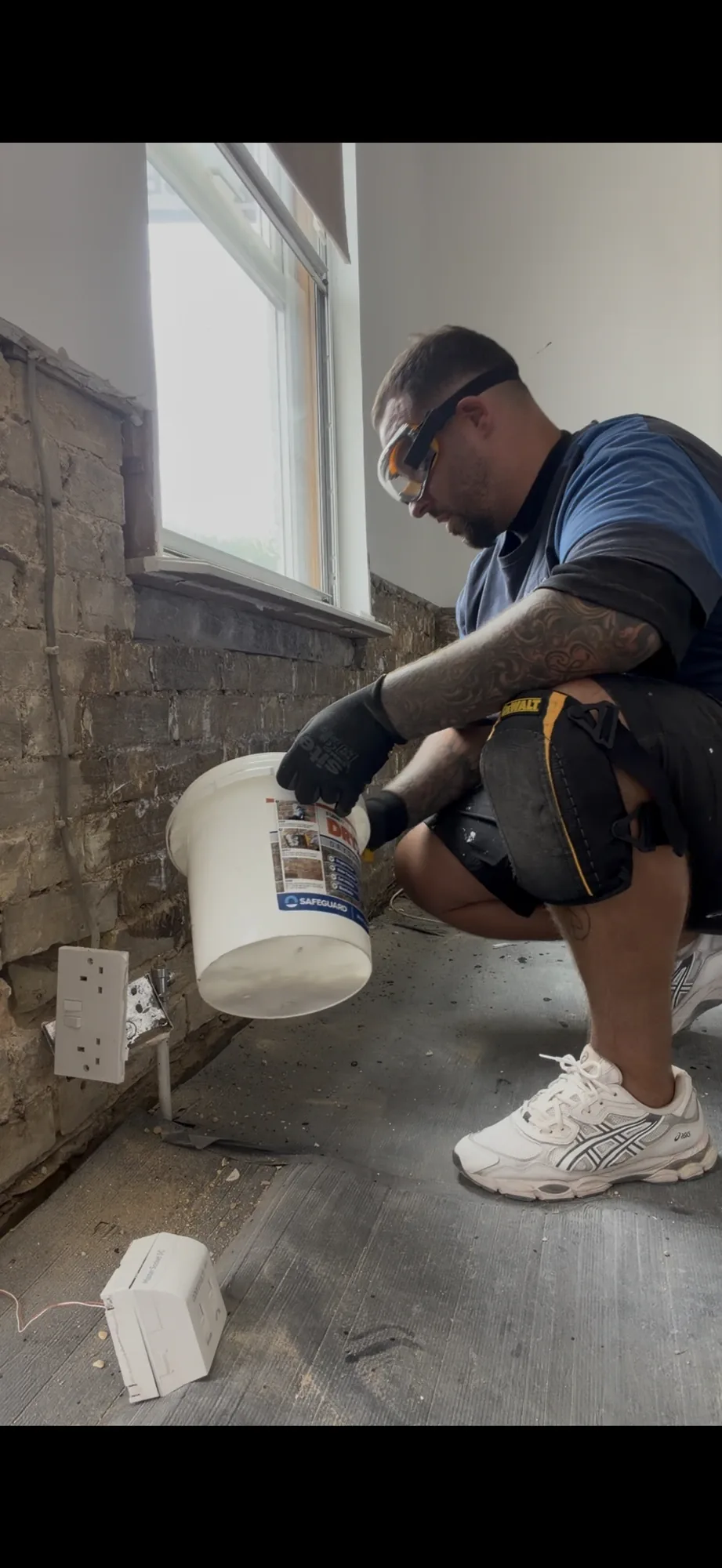
What a damp-proof course does
A damp-proof course is a horizontal barrier near the base of a wall that stops groundwater rising through the masonry by capillary action. Since the late nineteenth century it has usually been built in as slate, engineering brick, bitumen or polythene. Where a wall has none, or where the original has been breached, a retrofitted chemical damp-proof course can be installed by injecting a water-repellent formulation, normally silane or siloxane based, into a line of drilled holes in a mortar bed so that it spreads through the pores and lines them. It is a genuine and effective piece of engineering in the right circumstances. The question is not whether it works, but whether rising damp is what you actually have.
The evidence that should exist first
Before a chemical course is specified, a reasonable investigation should have established several things. The damp should be confined to the lower part of the wall, typically the first metre, and present on walls in contact with the ground. It should be reasonably constant through the year rather than tracking rainfall. There should be an identifiable absence or failure of an existing course. Moisture should be demonstrable at depth in the masonry, not just at the plaster surface, which normally means carbide or gravimetric testing rather than a resistance meter alone. Hygroscopic salts consistent with ground moisture should be present. And the alternatives, bridging, leaks, penetrating damp and condensation, should have been examined and excluded in writing.
Bridging: the most common alternative
A great many walls with a perfectly sound damp-proof course are damp at low level because moisture is getting past it. Raised external ground, a patio or drive laid above internal floor level, a rendered plinth carried down over the course, soil banked against the wall, a solid floor screed continuous with the wall, mortar debris in the cavity, or an external step or planter all bridge the barrier. So does a blocked air brick that leaves a sub-floor void humid. In these cases injecting a second course achieves nothing, because the water is not coming through the line where the course sits. Correcting the bridge is usually cheaper, less disruptive and permanent.
How the work is carried out
Where a chemical course is justified, the usual sequence is to expose the mortar bed at the correct level, drill at the spacing and depth the product requires, inject under low pressure or by gravity feed until the masonry is saturated to the specified extent, and then make good. Both leaves of a cavity wall may need treatment depending on the situation, and internal walls built off the ground often need it too. In rubble-filled or highly irregular masonry, injection is less predictable and an alternative approach may be more appropriate. Any competent installer will explain which product is being used, at what centres, to what depth, and what guarantee is offered, in writing.
Why replastering usually follows
Where rising damp has been present for years, the plaster will normally be contaminated with hygroscopic salts. Those salts continue to draw moisture from the air after the wall itself is dry, so the surface stays damp and decoration keeps failing even though the treatment has worked. That is why a damp-proof course is generally accompanied by removing the affected plaster to an agreed height and replastering to a specification designed to resist salt migration, or by applying a suitable render system. It is also why the replastering specification matters as much as the injection: an inappropriate finish on a solid wall can trap moisture and create a new problem.
What a damp-proof course will not fix
It will not stop condensation, and it will not remove mould from a cold reveal. It will not cure penetrating damp from a defective gutter, a failed flashing or a saturated elevation. It will not resolve a leaking pipe. It will not dry a wall whose moisture comes from a high external ground level unless that level is corrected. It will not make a wall with bridged cavity insulation dry, and it will not treat decayed timber, which needs the moisture source removed first. If you have been offered a course for any of those symptoms, the diagnosis is worth re-examining before the money is committed.
Getting a second opinion
Our position is straightforward: we install chemical damp-proof courses where the evidence supports one, and we say so plainly when it does not, which happens often. An inspection examines the property inside and out, takes comparative readings and, where the decision hinges on it, deeper measurements, and produces a written report setting out the mechanism, the extent and a proportionate remedy. Where a course is recommended, the report explains why the alternatives were excluded, so you can see the reasoning rather than taking the recommendation on trust.
Alternatives to injection in difficult walls
Chemical injection is not the only method, and in some walls it is not the most reliable. In rubble-filled or highly irregular masonry, where the mortar bed is discontinuous, injection cannot be relied upon to form a continuous barrier, and other approaches are preferable. Physical insertion of a membrane into a cut bed joint is possible in regular brickwork and gives a positive barrier, at greater cost and disruption. Electro-osmotic systems exist but are used rarely and warrant careful scrutiny. In some older buildings the appropriate response is not a barrier at all but managing moisture instead: lowering external levels, reinstating breathable finishes, improving evaporation from the wall and accepting a degree of seasonal dampness at the base. Which of these is right depends on the construction, and that is a judgement an inspection should make explicitly.
Limitations of general guidance
This article is general guidance. It cannot confirm the cause of dampness in a specific property. Recommendations should follow an inspection of the building, its external environment and its internal conditions.
Book an inspection