
Damp
Damp investigations and moisture diagnosis
A structured investigation to establish the likely cause of dampness before any remedial work is recommended.
Accredited & certified
PCA Qualified Technician (PCAQT) — Damp & Timber
Our qualified technicians install damp proofing and timber preservation treatments with care and attention to detail.

CHAS Accredited Contractor
Assessed and accredited for health and safety management, so landlords, agents and homeowners can see our safe working practices have been independently checked.

UK Academy of Mould Experts Accredited
Corporate member of UKAME, working to recognised industry standards for the safe assessment and remediation of mould in domestic property.

Dewpoint Professional Certified
Certified in Advanced Mould Remediation, covering containment, safe removal and correcting the moisture conditions that allow mould to return.
Watch — how a damp investigation is carried out
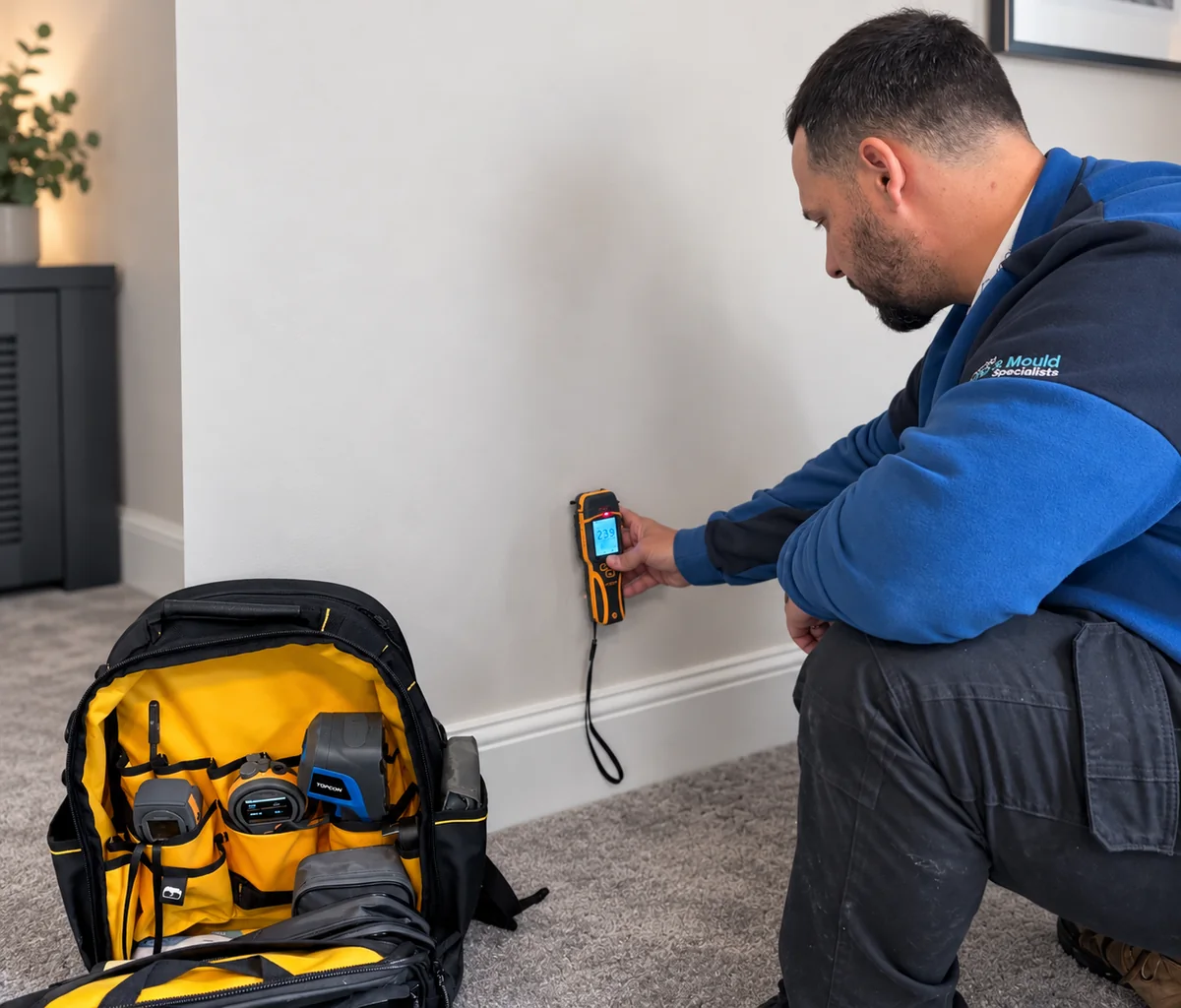
What our surveyor does at your property
Moisture readings across the affected wall, thermal imaging to show where the fabric is cold or wet, an external inspection of the brickwork, ground levels and rainwater goods, and then the findings explained to you in plain terms. Only then is any work recommended.
Symptoms and causes are not the same thing
The stain on the wall is the symptom, not the diagnosis
A damp patch tells you where moisture is reaching a surface. It does not tell you where that moisture came from, and the same patch can be produced by half a dozen different mechanisms with completely different remedies.
An investigation exists to close that gap. We are looking for the mechanism that explains all of the evidence — the readings, the distribution, the construction, the defects outside, the conditions inside and what the weather has been doing — rather than the first explanation that fits part of it.
What we weigh before offering a diagnosis:
Where the moisture sits, and how it is distributed vertically and horizontally
The construction of the wall and the type of floor
The presence, position and condition of any damp-proof course
External ground, path and paving levels
The condition of render, pointing, masonry and openings
Rainwater goods, roof, chimney and flashing details
Air temperature, relative humidity and dew point in the affected rooms
Surface temperatures on the affected construction
Timber moisture content where timber is at risk
Salt contamination in plaster and its effect on readings
Any history of leaks, works or previous treatments
Recent weather, occupancy and heating patterns
This is also why we will sometimes tell you that the evidence is not conclusive. Monitoring over a wet spell, a plumbing pressure test or opening up a small area is often cheaper and more honest than a confident guess.
What the issue is
A damp investigation is a methodical assessment of a property to establish where moisture is coming from. It considers the building fabric, external environment, internal conditions and occupancy patterns rather than relying on a single meter reading.
Common symptoms
- Visible damp patches or staining
- Peeling or blistering decoration
- Perished or hollow-sounding plaster
- Musty smells
- Black mould growth
- Salt deposits on walls
Likely contributing factors
- Defective rainwater goods
- Raised external ground levels
- Bridged or absent damp-proof course
- Plumbing leaks
- Insufficient ventilation and heating
- Failed pointing or render
Conditions that may be mistaken for it
- Condensation misread as rising damp
- Hygroscopic salt activity
- Historic staining from a resolved leak
- Construction moisture in newer work
How the issue should be investigated
- External inspection of walls, ground levels and rainwater goods
- Internal assessment of affected and adjacent rooms
- Moisture profiling using appropriate instruments
- Temperature and relative humidity readings
- Inspection of voids and subfloors where accessible
- Review of previous works and finishes
Potential treatment or repair options
- Targeted repair of the identified moisture source
- Improved ventilation where condensation is a factor
- Localised replastering only where the finish has failed
- Damp-proof course installation where genuinely justified
- Drainage or ground level correction
When treatment may not be appropriate
- Where readings are elevated but no moisture source is confirmed
- Where a simple building repair will resolve the issue
- Where the property is still drying following a resolved leak
Factors affecting the cost
- Property size and number of affected areas
- Accessibility of voids and external elevations
- Whether opening up or sampling is required
- Travel within the service area
- Depth of reporting required
What to expect during an inspection
A surveyor will inspect the affected areas and the wider building, take readings, photograph findings and discuss what is observed. Allow around 60 to 90 minutes for a typical domestic inspection.
What the instruments do
What our instruments can and cannot establish
Electrical moisture meters are useful and we use them constantly, but they measure electrical conductivity, not water. Salts, foil-backed plasterboard, metal fixings and even some paints can all produce a high reading in a dry wall.
That is why an electrical meter reading, on its own, is not evidence of rising damp. It is one input. Where the diagnosis depends on it, we take it further — carbide testing of drilled samples, a salts analysis, a hygrometer survey of the room or thermal imaging to show the pattern behind the plaster.
- Electrical resistance and capacitance meters for profiling and comparison
- Calibrated hygrometers for air temperature, relative humidity and dew point
- Surface temperature measurement to establish condensation risk
- Thermal imaging where a pattern needs to be seen rather than inferred
- Carbide or gravimetric sampling where an absolute moisture content is needed
- Salts analysis where hygroscopic contamination is suspected
Related work
Where an investigation usually leads
Rising damp assessments
Capillary moisture, damp-proof courses, bridging and salt contamination assessed on the evidence rather than a meter reading.
Penetrating damp investigations
Rainwater and external defects traced to the elevation, opening or rainwater fitting responsible.
Condensation control
Humidity, dew point and surface temperatures measured before any equipment or insulation is recommended.
Mould remediation
Safe removal of the contamination, and control of the moisture conditions that allowed it to grow.
Timber preservation
Decay and insect activity assessed against the moisture conditions that made the timber vulnerable.
Damp surveys and moisture investigations
What a professional damp investigation covers, what the instruments can and cannot establish, and what your written report contains.
Where we work
Damp investigation across Bedfordshire, Northamptonshire and Cambridgeshire
Damp investigation is carried out across our operating area. Choose your county or town to see the work we do locally, the postcode districts we cover and how to arrange an inspection.
Frequently asked questions
Next step
Not sure which inspection you need? Start with a few questions.
Tell us what you are seeing and we will set out what is likely, what is uncertain and which inspection would answer the question. Speak to us on 0333 335 6152 if you would rather talk it through.