

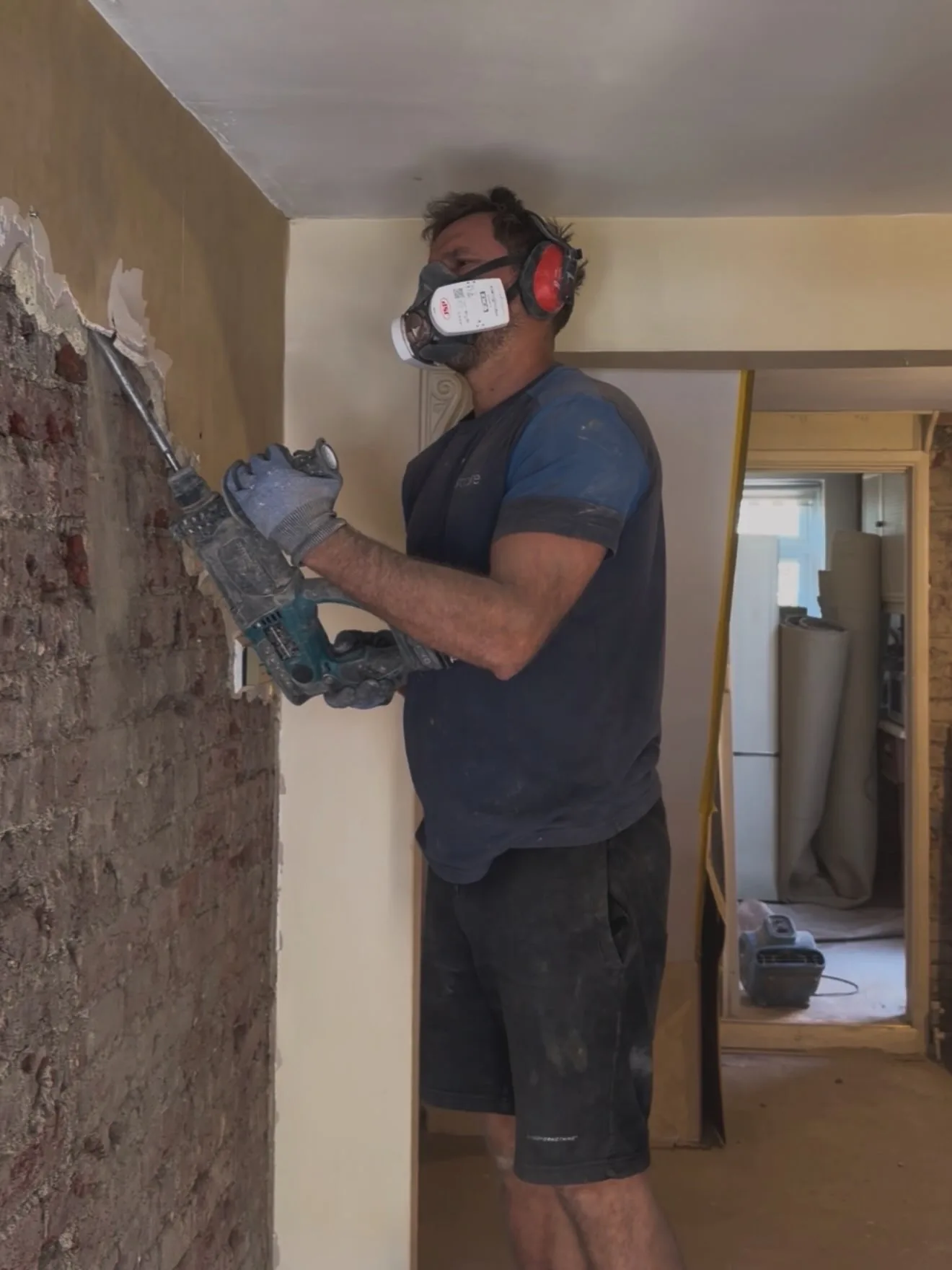
Why plaster becomes the problem
Plaster is often the last thing dealt with in a damp repair and the first thing to fail afterwards. There are three reasons it may need replacing. It may have lost adhesion, because moisture has broken the bond with the background or because the plaster itself has deteriorated. It may be contaminated with hygroscopic salts carried out of the masonry by evaporating water, so that it continues to draw moisture from the air and stays damp even after the wall is dry. Or it may be the wrong material for the wall, typically a dense cement or gypsum finish on a solid wall that needs to breathe. Each of those has a different remedy and a different extent.
Salt contamination and why it persists
Groundwater carries nitrate and chloride salts. As water evaporates from a wall surface, the salts are deposited in the plaster, often concentrated in a band at the top of the damp zone, which is what produces the visible tide mark. Those salts are hygroscopic: they absorb water vapour from the room air at ordinary humidities. The practical consequence is that a wall can be perfectly dry at depth while the plaster surface still reads damp, still feels cold and damp to the touch in humid weather, and still causes decoration to fail. No amount of drying time resolves that, because the salts are not going anywhere. Removing and replacing the affected plaster is the only reliable answer where contamination is significant.
What can usually be kept
Plenty of damp-affected plaster can stay. Plaster that is sound, well adhered and only superficially discoloured, on a wall whose moisture source has been corrected, can often be allowed to dry, cleaned, and redecorated with a breathable finish once readings have stabilised. Plaster affected by a short-lived leak, where salts have not been drawn out of the ground, is frequently salvageable. Historic staining in a dry wall may need nothing more than a stain-blocking preparation. Stripping every wall in a room as a matter of routine is expensive, disruptive and often unnecessary; the decision should follow tapping for hollowness, probing, and measurement rather than a default specification.
How the extent is decided
Where replastering is needed, the extent is normally taken to a height above the visible damp and salt band, commonly to at least 300mm to 500mm above the highest damp reading, because salt migration extends beyond what is visible. In practice the line is often taken to a convenient architectural feature, such as a dado or a full metre, so the finish is not obvious. It should be agreed and set out in writing before the work starts, along with what happens to skirtings, architraves, electrical fittings and floor protection. Removal generates a great deal of dust, and how that is controlled should also be agreed in advance.
Specification matters as much as extent
The replacement specification depends on the wall. Where a chemical damp-proof course has been installed in a solid wall with salt contamination, a render system designed to resist salt migration, applied in the coats and thicknesses the manufacturer specifies, is the usual approach, and shortcuts in mix or thickness are a common reason for later failure. Where a solid wall needs to breathe, particularly in an older or listed building, lime-based plasters and breathable finishes are appropriate, and a dense cement render would trap moisture and move the problem elsewhere. Insulated render and drylining on battens are alternatives in specific situations, but they change the way the wall behaves and need designing rather than choosing.
Timing: the most common mistake
Replastering before the wall has dried is the single most frequent cause of repeat failure. Masonry dries slowly, roughly a month for every 25mm of thickness in favourable conditions, and a saturated solid wall can take many months. New plaster applied over a wet background will fail, and the decoration over it will fail sooner. Where a programme cannot wait, the specification has to account for the residual moisture, and that should be a conscious decision recorded in the report rather than an oversight. Readings taken at intervals, ideally at depth, tell you when the background is ready.
Getting a proportionate specification
If you have been quoted for stripping and replastering whole rooms, it is reasonable to ask which walls are salt contaminated and on what evidence, to what height and why, what specification is proposed and why it suits the wall, and how the background moisture will be confirmed before work starts. Our reports set that out, and where we find that plaster can be dried and redecorated rather than replaced, we say so. The difference between a proportionate and a wholesale specification on an average house is frequently several thousand pounds.
Dust, disruption and what replastering involves
Removing damp-affected plaster is the messiest part of most damp repairs, and knowing what it involves helps you plan. Walls are hacked off to the agreed height with percussive tools, which is noisy and generates a great deal of fine dust that will travel through open doors. Skirtings and architraves usually come off and are not always reusable. Sockets and switches on the affected walls need isolating. The debris is bagged and removed, then the new system is applied in coats with drying time between them, and the finish needs several weeks before full decoration. Rooms are best emptied, and where that is impossible, contents should be covered and internal doors kept closed. Agreeing in advance who moves furniture, lifts carpets and reinstates joinery avoids the most common misunderstanding on this kind of job.
Limitations of general guidance
This article is general guidance. It cannot confirm the cause of dampness in a specific property. Recommendations should follow an inspection of the building, its external environment and its internal conditions.
Book an inspection