

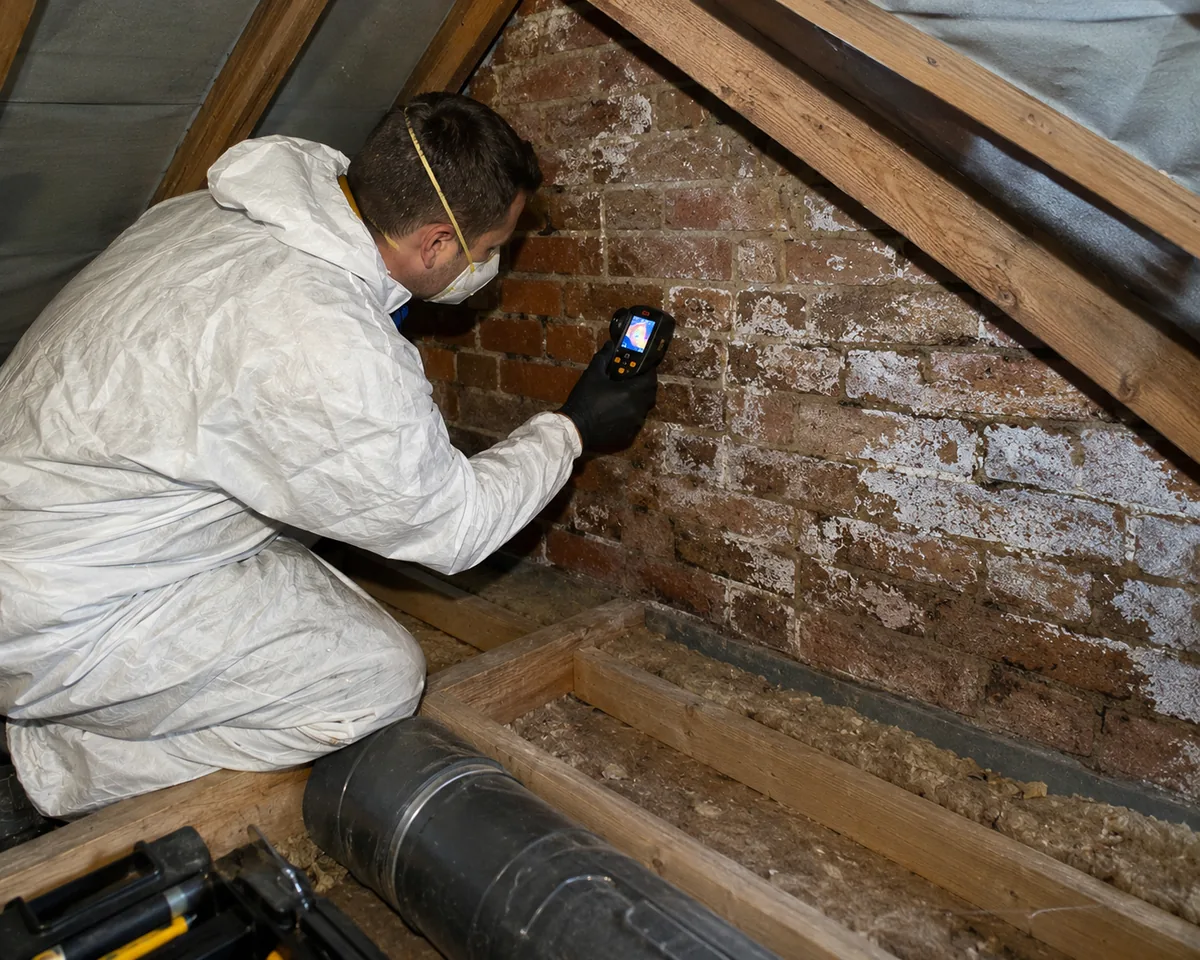
What wet rot is
Wet rot is decay of timber by fungi that need consistently high moisture content to survive, generally above about 20 to 22 per cent and often considerably higher. Several species are involved, and they fall broadly into brown rots, which leave the wood darkened, cracked and crumbling, and white rots, which leave it lighter, fibrous and stringy. What matters practically is that wet rot is a consequence rather than a cause. It grows where water has been present for a long time, and it stops progressing when the timber dries. That single fact shapes every sensible response to it: find the water, remove it, and the decay ceases.
Where it starts in a house
The pattern is consistent. Joist ends and wall plates bearing into external walls that have been saturated by a failed gutter or high ground level. Floor timbers over a sub-floor void whose air bricks have been blocked. The bottoms of door frames and thresholds where splashing rain collects. Window sills and the lower rails of older timber windows where paint has failed and water sits in the joint. Timbers below a long-term plumbing leak, a failed shower tray or a leaking waste. Roof timbers under a slipped tile, a failed valley or a defective flashing. In almost every case the water arrived from an identifiable, repairable defect.
How to recognise it
Affected timber is usually softer than sound timber and can be probed with a screwdriver or bradawl with little resistance. Brown rot leaves cuboidal cracking across and along the grain and a darkened, friable surface; white rot leaves a bleached, fibrous texture. There may be a musty smell, localised rather than general. Paint or a finish over the decay often looks intact until it is pressed, because the damage is beneath. Skirtings, architraves and frames that give under pressure, floorboards that feel spongy near a wall, and a window rail that crumbles at the corner are all typical findings. Moisture readings on the affected timber will be high, which distinguishes active decay from historic damage in dry wood.
Wet rot and dry rot are not the same problem
The distinction matters because the response differs in scale. Dry rot, Serpula lacrymans, is a brown rot that can transport water through its own strands, so once established it can spread through and across masonry into drier timber some distance away, and it needs a much more thorough response. Wet rot cannot do that: it is confined to the timber that is actually wet. Dry rot typically shows rust-red spore dust, greyish strands, white cotton-wool growth in humid conditions and a distinctive mushroomy smell, along with deep cuboidal cracking. Identifying which one is present, and getting that right, changes both the extent of the work and its cost, so it should be established on site rather than assumed.
Why the repair starts with the water
Applying a fungicide to decayed timber while the leak continues is close to useless. The correct sequence is to identify and repair the moisture source, allow the structure to dry, then establish the extent of the decay by probing and measurement, then replace or splice the timber that has lost structural capacity, treating adjacent sound timber only where the situation warrants it. Where a joist end has decayed, the options are typically cutting back to sound timber and splicing a new section, or supporting on a new bearing away from the damp masonry, with an isolating membrane. The point is that the design decision follows the drying, not the other way round.
What can be left alone
Not all decay needs removing. Superficial surface decay on a non-structural member in a location that is now dry can often be cleaned, consolidated and redecorated. Historic damage in a timber that has dried and retains adequate section may need nothing at all. Blanket recommendations to replace all timber in an area, or to spray a whole floor, are rarely justified by the evidence. A report that quantifies the affected members, states their moisture content, and says which have lost load-bearing capacity gives you a basis for a proportionate repair rather than a wholesale one.
When to have timber inspected
What a timber repair typically costs to put right
Costs depend far more on access than on the decay itself. Replacing a decayed section of skirting or a window rail is a joinery job of a few hundred pounds. Splicing a decayed joist end where a floor can be opened from above is a day's work for two people plus materials. The same repair under a fitted kitchen, a tiled floor or a staircase can cost several times as much because of what has to come out and go back. Repairing the moisture source, a gutter, a leaking waste, a ground level, is usually the cheapest part of the whole exercise and the part that determines whether the repair lasts. This is why we quantify affected members individually rather than pricing by the room: a proportionate schedule is often a fraction of a blanket one.
Limitations of general guidance
This article is general guidance. It cannot confirm the cause of dampness in a specific property. Recommendations should follow an inspection of the building, its external environment and its internal conditions.
Book an inspection