

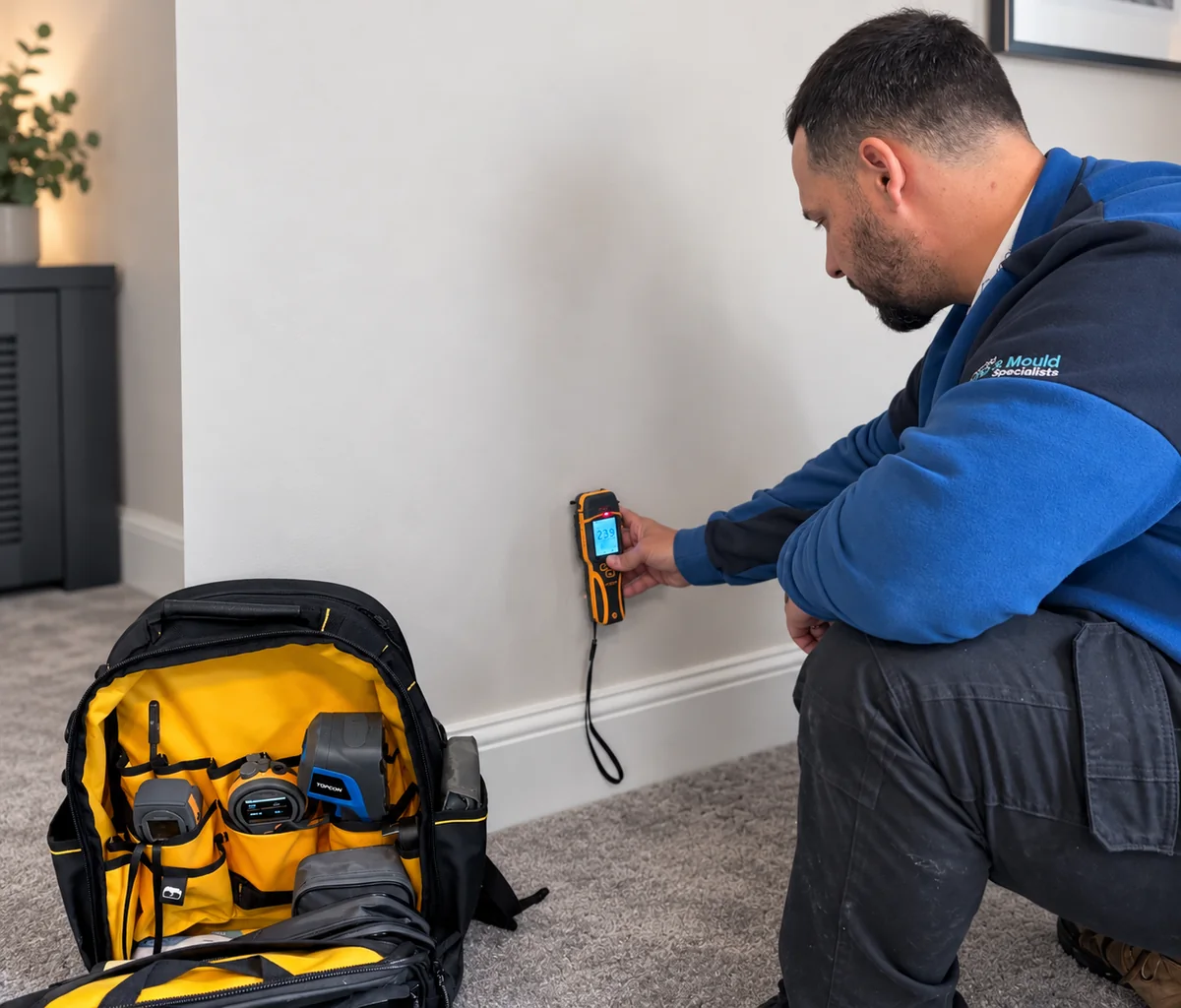
What the common meter actually measures
The hand-held instrument used on most damp inspections is an electrical resistance meter. Its two pins measure how easily a current passes between them, and it converts that into a number or a colour. In timber, which is what these meters were designed and calibrated for, the relationship between electrical resistance and moisture content is reliable, and a reading can reasonably be quoted as a percentage. On plaster, brick, stone and concrete it is not calibrated at all. Anything that makes the material more conductive raises the reading, and water is only one of those things. That does not make the meter useless; it makes it an indicator that has to be interpreted rather than a measurement that can be quoted as proof.
Why salts distort the picture
Where moisture has been moving through masonry, it carries dissolved salts with it, chiefly nitrates and chlorides from the ground, and leaves them behind in the plaster when it evaporates. Those salts are conductive and hygroscopic: they conduct electricity readily and they draw moisture directly out of the room air. A salt-contaminated plaster surface will therefore give a very high resistance reading even when the wall behind it is dry, and it can feel damp in humid weather years after the original source was cured. This is one of the most common reasons a property is treated for rising damp that no longer exists, and it is why a high surface reading should prompt further investigation rather than a quotation.
Other things that raise a reading
Foil-backed plasterboard, metal lath, wall ties, foil-backed insulation, pipes, cables, carbon-containing paints, hard black wall finishes and even dense mortar can all give high or erratic readings that have nothing to do with water. Surface condensation and recent cleaning will raise a reading temporarily. Capacitance meters, which read a short distance into the material without pins, avoid puncturing the surface but are equally affected by embedded metal and density changes, and they cannot tell you at what depth the moisture sits. A competent inspection notes what is behind the surface before drawing conclusions from what appears on the dial.
What a reading is genuinely good for
Comparative work is where these instruments earn their place. Taking readings at 100mm intervals up a wall and mapping where they fall away shows the profile of the dampness, which is one of the strongest pieces of evidence available: a profile that declines steadily from the base is consistent with rising damp or bridging, while a band of high readings at mid-height is not. Comparing the same height across several walls shows whether one elevation is affected. Repeating a set of readings after a month in dry weather shows whether the problem is active or historic. None of that requires the meter to be accurate in absolute terms; it only requires it to be consistent.
Tests that do give firm answers
Where the question matters, and it usually matters most before a substantial treatment is commissioned, there are better tests. A carbide (Speedy) test on drilled masonry samples gives the actual moisture content of the material at depth by weight, which surface meters cannot do. Gravimetric analysis in a laboratory, where samples are weighed, oven-dried and reweighed, is the reference method. A salt analysis on the same samples shows whether nitrates and chlorides are present at levels consistent with historic ground moisture, which separates active rising damp from an old problem with contaminated plaster. Hygrometer and surface temperature measurements, or a thermal image, identify condensation risk that no meter will show.
Reading a report that quotes percentages
If a report on masonry quotes moisture as a percentage from a resistance meter, treat that figure with caution and look for what accompanies it. A well-founded report will describe the pattern and profile of the readings, note what lies behind the surfaces tested, record humidity and temperature, describe the external condition of the wall, ground levels and rainwater goods, and explain how alternative causes were excluded. A report that offers a single high reading and a recommendation for injection and replastering has not established a cause. You are entitled to ask which mechanism has been evidenced, and how.
What to do with a reading you have been given
If a surveyor's report or a contractor's visit has produced high readings, the useful next step is interpretation rather than treatment. That means establishing whether the moisture is at depth or confined to the surface, whether salts are present, whether there is an external defect or a leak, and whether the room conditions would produce condensation on that surface anyway. We are happy to review an existing report and explain what it does and does not establish. In a good number of cases the readings turn out to be historic contamination or a condensation pattern, and the money that would have gone on a damp-proof course goes on something that was actually needed.
What a good set of readings looks like in a report
If you want to judge the quality of a damp report, look at how the readings are presented. A well-made record shows where each reading was taken, at what height and on what material, with a plan or annotated photographs rather than a single figure in a sentence. It includes comparative readings on unaffected walls so you can see what normal looks like in that building. It records the room temperature and relative humidity at the time, and the surface temperature where condensation is in question. Where the conclusion depends on the moisture content of the masonry, it includes readings at depth or a carbide test rather than surface readings alone. And it states the instrument used and its limitations. Reports of that standard support a decision; a lone percentage figure does not.
Limitations of general guidance
This article is general guidance. It cannot confirm the cause of dampness in a specific property. Recommendations should follow an inspection of the building, its external environment and its internal conditions.
Book an inspection