

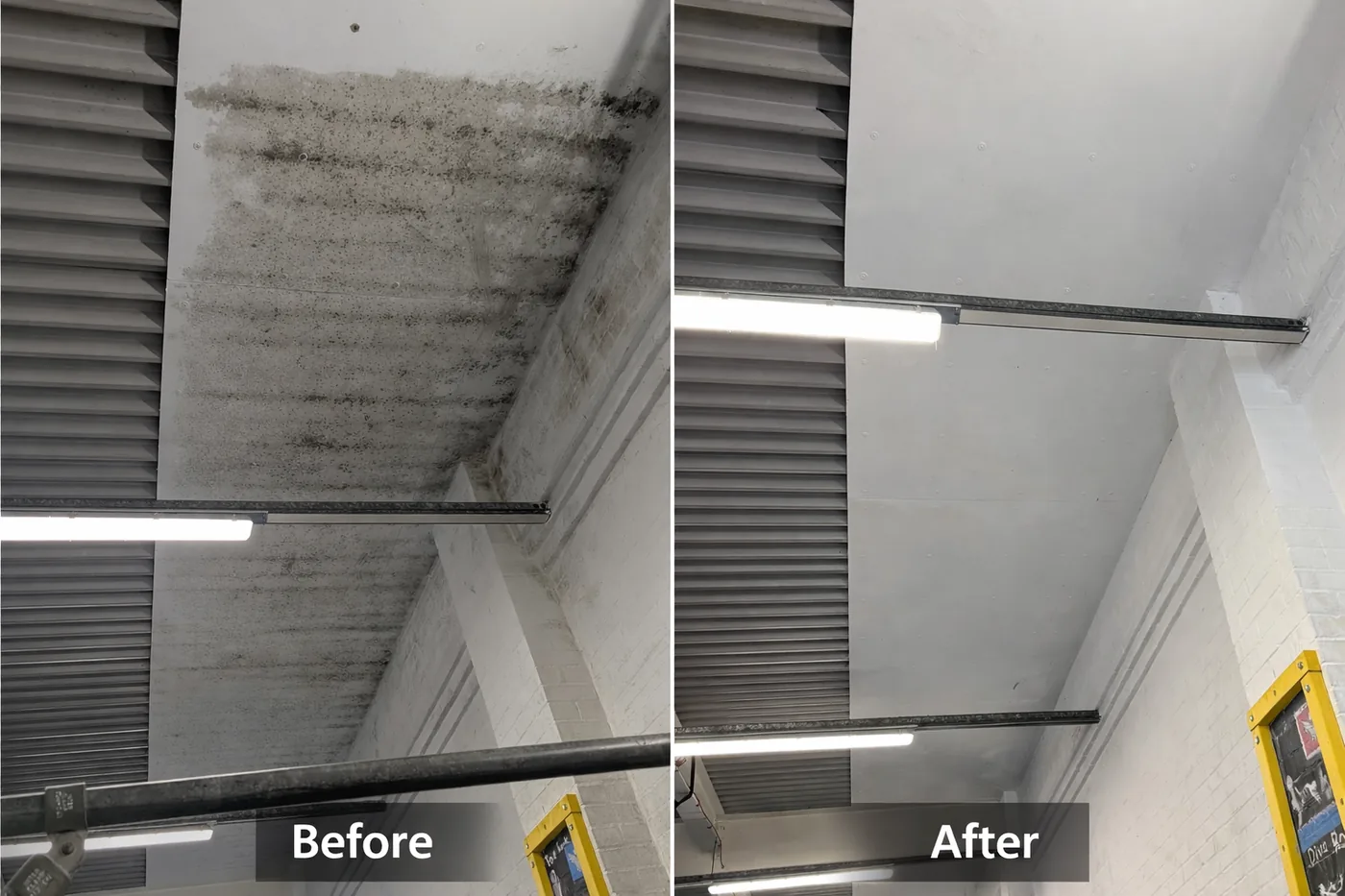
Cleaning treats the symptom
Mould is a living organism, and like anything living it needs food, warmth and water. In a house the food and warmth are already provided: wallpaper paste, emulsion, plaster, dust and skin cells are all nutrients, and room temperature suits most household moulds perfectly well. Water is the only variable you control. Cleaning removes the visible colony and reduces the spore load on that surface, but it changes nothing about the humidity of the room or the temperature of the wall. If those conditions remain as they were, the same surface will be recolonised from the spores that are present in all indoor air, generally within four to twelve weeks in the colder half of the year.
The conditions mould needs
Most indoor moulds become active where the relative humidity at a surface stays above roughly 80 per cent for extended periods, which happens long before visible water appears. Two things drive that: how much moisture is in the room air, and how cold the surface is. A room at 20°C and 60 per cent relative humidity is comfortable, but a wall surface at 12°C in the same room sits close to dew point, and a corner behind a wardrobe may be colder again. This is why mould appears in patches rather than everywhere, and why it favours external corners, window reveals, unheated bedrooms, inside built-in cupboards and behind furniture pushed against outside walls.
Where the moisture is coming from
Ordinary occupation puts a surprising amount of water into the air: cooking, showering, washing up, houseplants, and above all drying laundry indoors, which can release several litres from a single load. Add unflued portable heating and the figure rises sharply. Fabric sources need excluding too, because mould will also colonise a wall wetted by a leak or by penetrating damp. Before concluding that a problem is purely about humidity, it is worth checking for a plumbing leak behind or below the affected area, a defective gutter or downpipe on that elevation, a failed flashing above it, and ground levels or bridging at the base of the wall.
Extraction that does not work
Most houses have extract fans in the kitchen and bathroom, and a considerable number of them achieve very little. Common faults are easy to identify: a duct that is long, kinked or uninsulated so that moist air condenses inside it and runs back; a run that discharges into a loft or a cavity instead of outside; a blocked or painted-over external grille; a fan far too small for the room; a fan wired to the light so that it runs for two minutes and stops; and simply not using it. A fan is doing its job if it clears the mirror steam within a few minutes with the door closed and continues running for fifteen to twenty minutes after use. If it does not, the moisture is staying in the house.
What to measure before spending money
A cheap hygrometer left in the affected room for a fortnight, logging temperature and humidity, is more useful than any amount of speculation. An infrared thermometer showing the surface temperature of the mouldy area, compared with the middle of the same wall, identifies a cold bridge. A moisture meter and, where necessary, deeper readings in the masonry distinguish a wet wall from a cold one. Those three measurements, plus a look at the fans and the outside of the building, are what an assessment brings together, and they usually make the cause and the proportionate remedy obvious.
Measures that work, in order
Reduce moisture at source first: extract properly while cooking and bathing, keep internal doors closed while doing so, dry laundry outdoors or in one extracted room, and cover pans. Then keep surfaces warmer: a steady, moderate background temperature in the affected rooms costs less in redecoration than intermittent bursts of heat, and leaving a gap behind furniture on external walls allows air to reach the surface. Then address the fabric where it is genuinely cold: insulated reveals and closers, insulation to a specific cold bridge, or improved extraction as a designed system. Finally, clean and treat the affected surfaces once the conditions have changed, so the treatment has something to hold.
What rarely helps
Anti-mould paint applied over a cold, damp surface buys a season at best; the coating resists growth on its own film but does nothing about the dew point behind it. A dehumidifier is useful while a building dries out or as a stop-gap, but running one permanently to compensate for a fan that discharges into the loft is an expensive way to avoid a cheap repair. Sealing a room up makes matters worse, as does heating it briefly and letting it cool. And injecting a damp-proof course into a wall whose problem is surface condensation will change nothing at all, which is why the diagnosis has to come first.
When to ask for an assessment
If mould has returned twice in the same place, if it covers more than a small area, if anyone in the household has a respiratory condition, or if you are a landlord responding to a tenant's report, it is worth having the conditions measured and documented. An assessment records humidity, surface temperatures, moisture readings and the performance of the extraction, identifies any fabric defect contributing to it, and sets out what should be done in what order, with photographs. That record is also the evidence a landlord needs when demonstrating that a complaint has been investigated properly.
Limitations of general guidance
This article is general guidance. It cannot confirm the cause of dampness in a specific property. Recommendations should follow an inspection of the building, its external environment and its internal conditions.
Book an inspection