

What a specialist survey adds
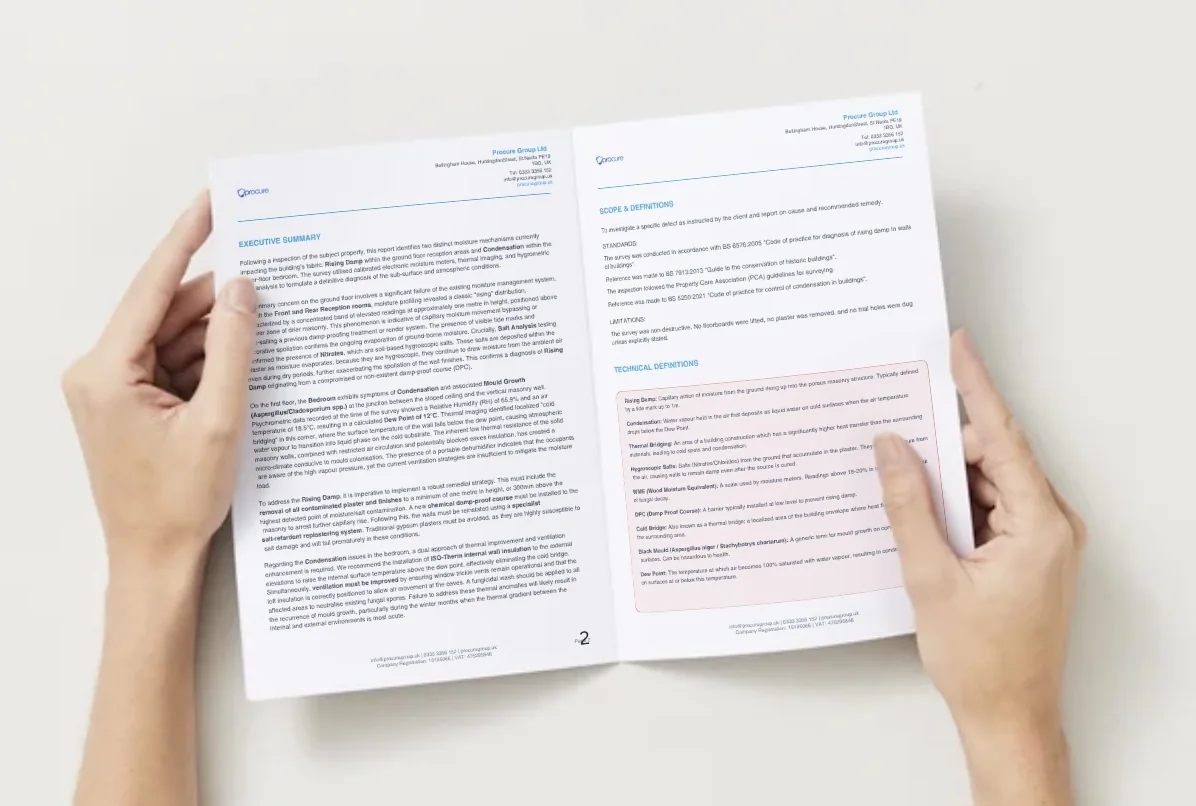
A general building survey assesses a whole property against its age and type. A specialist damp survey does one thing in depth: it establishes why a building is wet. It brings moisture profiling, psychrometric readings, surface temperatures, an external defect inspection and, where necessary, sampling — and it produces a written diagnosis with reasoning and recommendations.
When it is clearly worth it
When a survey or a report has recommended further investigation by a specialist; when damp has returned after previous remedial work; when a contractor has quoted significant work without measuring anything; when mould keeps coming back in the same place; when timber decay is suspected; and when you need a written position for a tenant, a managing agent, a freeholder, an insurer or a solicitor.
When to wait
If a single obvious defect explains everything — an overflowing gutter, a visibly leaking downpipe, a failed sealant joint above the damp patch — then fix that first and see what happens over the following weeks. Some damp is a maintenance job, and no honest surveyor wants to charge you to identify a blocked gutter you can see from the garden.
What to have ready
Photographs of the damp over time, ideally including during wet weather; any previous survey, report or quotation; the history of the property as you know it, including previous treatments and leaks; and access to every elevation outside and to the affected rooms inside. Access to a subfloor void or roof space is useful where timber is in question.
Questions worth asking any damp surveyor
Will I get a written report with photographs and reasoning? Will you measure humidity and surface temperatures, or only use a moisture meter? Will the outside of the building be inspected? What will you do if the evidence is inconclusive? Will the report state its limitations? A surveyor who cannot answer those clearly is not conducting an investigation.
Commercial honesty
We carry out remedial work as well as inspections, and we say so plainly rather than describing ourselves as independent. That is precisely why the findings, readings and photographs are all recorded: the recommendation has to stand on the evidence, and the report is written so you can take it to another contractor and get a comparable price.
Limitations of general guidance
This article is general guidance. It cannot confirm the cause of dampness in a specific property. Recommendations should follow an inspection of the building, its external environment and its internal conditions.
Book an inspection