
Accredited & certified
PCA Qualified Technician (PCAQT) — Damp & Timber
Our qualified technicians install damp proofing and timber preservation treatments with care and attention to detail.

CHAS Accredited Contractor
Assessed and accredited for health and safety management, so landlords, agents and homeowners can see our safe working practices have been independently checked.

UK Academy of Mould Experts Accredited
Corporate member of UKAME, working to recognised industry standards for the safe assessment and remediation of mould in domestic property.

Dewpoint Professional Certified
Certified in Advanced Mould Remediation, covering containment, safe removal and correcting the moisture conditions that allow mould to return.
Why a specialist inspection
Fourteen different mechanisms, one damp patch
Damp is not a single defect. These are the mechanisms we routinely find behind identical-looking damage, each with its own remedy and its own cost:
Rainwater penetration through masonry, render or pointing
Defective, blocked or discharging rainwater goods
Roof, chimney, flashing or flaunching defects
Water tracking in around windows, doors and failed sealant
External ground or paving above the damp-proof course
Internal render, screed or debris bridging the damp-proof course
Capillary rise through porous masonry
Hygroscopic salt contamination holding moisture in plaster
Surface condensation on cold walls, reveals and ceilings
Interstitial condensation within the construction
Thermal bridging at junctions, lintels and reveals
Plumbing and heating leaks, including pipes within floors
Water ingress into below-ground structures
Inadequate airflow and extract in kitchens, bathrooms and utility spaces
Two of these can easily be present at once — a cold wall that also has a leaking gutter above it — which is why we report on what we find rather than picking the single most convenient answer.
Owners, landlords and managing agents come to us for the same reason: a documented position on what is actually wrong, written so it can be handed to a contractor, an insurer, a freeholder or an occupier.
What the issue is
A specialist damp survey sets out what was inspected, what was observed, what the evidence supports and what remains uncertain, along with proportionate recommendations.
Common symptoms
- A need for a formal written report
- Disputed or unclear previous advice
- Landlord or agent requirements
- Multiple or complex damp issues
Likely contributing factors
- Combined causes across a property
- Historic works of unknown quality
- Building defects and occupancy factors together
Conditions that may be mistaken for it
- Single-cause assumptions
- Meter readings interpreted in isolation
How the issue should be investigated
- Full internal and external inspection
- Moisture, temperature and humidity recording
- Timber and ventilation assessment
- Photographic recording
- Clear statement of limitations
Potential treatment or repair options
- A structured report with recommendations
- Prioritised remedial options
- Referral to other trades where relevant
- A quotation where works are required
When treatment may not be appropriate
- Where a shorter assessment would answer the question
- Where remedial work is recommended without supporting evidence
Factors affecting the cost
- Property size and complexity
- Number of areas to be reported on
- Level of detail required
- Any specialist testing
What to expect during an inspection
A thorough inspection, typically 90 minutes or more, followed by a written report emailed to you by our office.
What you receive
A written report you can act on
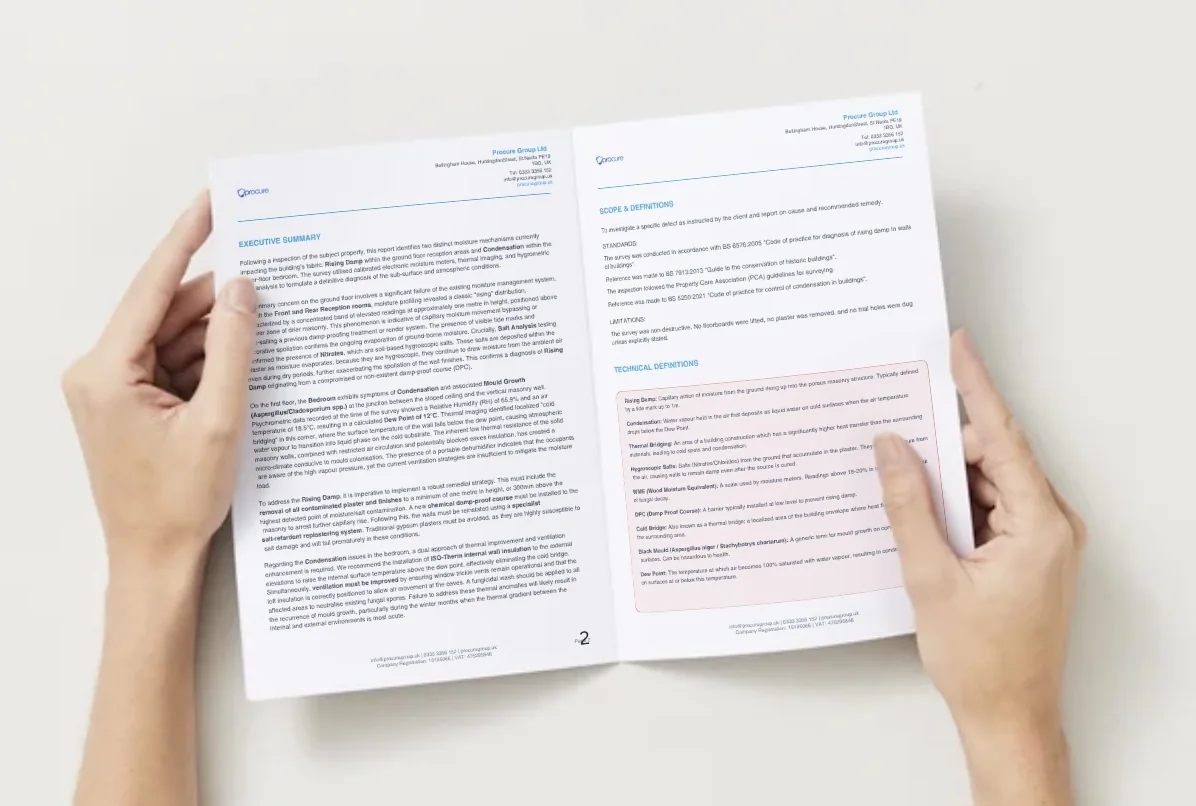
Every survey produces a document, not a verbal opinion. It records what was inspected, what was measured, what we concluded and why, with photographs of the evidence and a clear statement of what the inspection could not cover.
- Your instructions and the property details
- The scope of the inspection, and its limitations
- A description of the construction as found
- External and internal observations
- Moisture findings, with the method used for each
- Environmental readings where relevant to the diagnosis
- Photographs of the evidence relied on
- The likely cause, and the reasoning that supports it
- Recommendations, in priority order
- Any further investigation we consider necessary
Related work
Investigations for a particular mechanism
Rising damp assessments
Capillary moisture, damp-proof courses, bridging and salt contamination assessed on the evidence rather than a meter reading.
Penetrating damp investigations
Rainwater and external defects traced to the elevation, opening or rainwater fitting responsible.
Condensation control
Humidity, dew point and surface temperatures measured before any equipment or insulation is recommended.
Damp proofing
Why damp proofing is not one treatment, and how the right remedial specification follows the diagnosis.
Below-ground damp protection
Damp at or just below external ground level investigated, and localised below-ground damp protection where remediation calls for it. We do not install basement or cellar waterproofing.
Timber preservation
Decay and insect activity assessed against the moisture conditions that made the timber vulnerable.
Where we work
Specialist damp surveying across Bedfordshire, Northamptonshire and Cambridgeshire
Specialist damp surveying is carried out across our operating area. Choose your county or town to see the work we do locally, the postcode districts we cover and how to arrange an inspection.
Frequently asked questions
Next step
Not sure which inspection you need? Start with a few questions.
Tell us what you are seeing and we will set out what is likely, what is uncertain and which inspection would answer the question. Speak to us on 0333 335 6152 if you would rather talk it through.