
Timber
Dry rot investigation and treatment
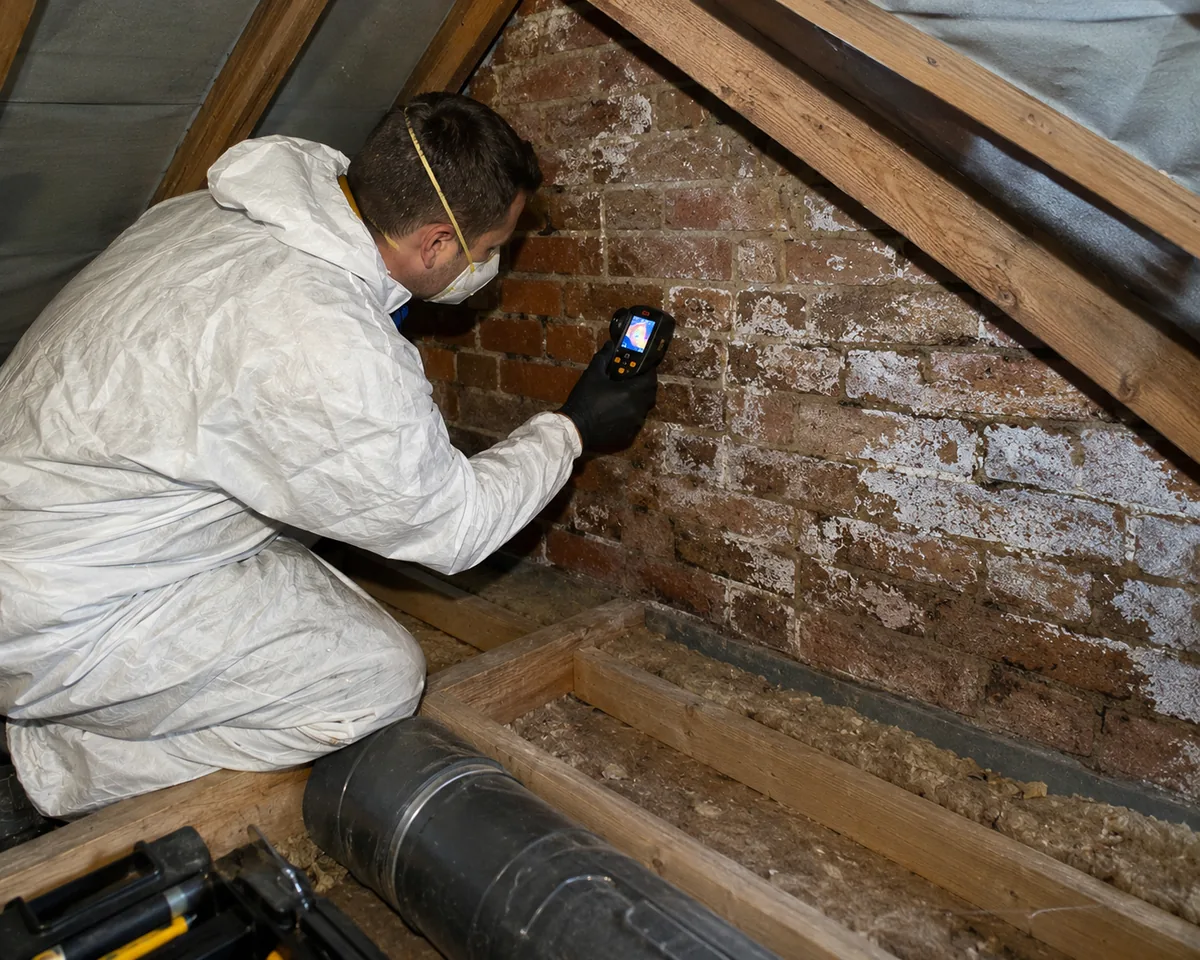
Careful investigation of suspected dry rot, which can extend beyond visibly damp timber.
Accredited & certified
PCA Qualified Technician (PCAQT) — Damp & Timber
Our qualified technicians install damp proofing and timber preservation treatments with care and attention to detail.

CHAS Accredited Contractor
Assessed and accredited for health and safety management, so landlords, agents and homeowners can see our safe working practices have been independently checked.

UK Academy of Mould Experts Accredited
Corporate member of UKAME, working to recognised industry standards for the safe assessment and remediation of mould in domestic property.

Dewpoint Professional Certified
Certified in Advanced Mould Remediation, covering containment, safe removal and correcting the moisture conditions that allow mould to return.
Correct identification first
What dry rot actually looks like
Serpula lacrymans produces a recognisable set of indicators, and telling them apart from wet rot changes both the investigation and the repair. No single sign is conclusive on its own, so we look for a consistent picture.
- Deep cuboidal cracking of the timber, across and along the grain
- Timber that is dry, light and crumbles readily when decayed
- White to grey mycelium, sometimes described as cotton wool
- Fine grey strands, which may extend across masonry and plaster
- Fruiting bodies with a rust-coloured, spore-covered surface
- Rust-red spore dust settling on nearby surfaces
- A distinctive damp, mushroom-like odour
What the issue is
Dry rot is a specific fungal decay capable of spreading through masonry to reach further timber. It requires accurate identification and a properly considered scope of works.
Common symptoms
- Cuboidal cracking of timber
- Fine white or grey strands
- Rust-coloured spore dust
- Mushroom-like fruiting bodies
- Strong musty smell
Likely contributing factors
- A sustained water source such as a leak
- Poorly ventilated voids
- Timber built into damp masonry
- Concealed damp areas
Conditions that may be mistaken for it
- Wet rot
- Other fungal growth
- General mould growth
How the issue should be investigated
- Identify fungus type from visible characteristics
- Trace the extent of spread where accessible
- Establish and confirm the moisture source
- Assess structural implications
Potential treatment or repair options
- Eliminating the moisture source
- Removal of affected timber with an appropriate margin
- Masonry treatment where justified
- Improved ventilation and drying
- Structural repairs
When treatment may not be appropriate
- Where the fungus is misidentified and the issue is wet rot
- Where extensive masonry treatment is proposed without evidence
Factors affecting the cost
- Extent of opening up and removal
- Structural support and repairs
- Masonry treatment area
- Reinstatement of finishes
What to expect during an inspection
A detailed inspection which may require limited opening up to establish the extent, agreed with you in advance.
How we deal with it
Investigation, moisture control, then repair
- 1
Find and stop the water
Dry rot cannot become established in dry timber. The leak, defect or bridging feeding the outbreak is identified and corrected first — without that, everything else is temporary.
- 2
Establish the extent
Exposure of affected areas to trace the outbreak through timber and, where relevant, across masonry, so the true boundary is known before repairs are priced.
This stage often needs floors lifted or linings removed. We would rather cost the exposure honestly than quote a repair on an assumed extent. - 3
Remove and repair
Decayed timber that has lost structural integrity is cut out and replaced, with new timber isolated from damp masonry and with adequate airflow around it.
- 4
Dry the structure
Masonry and remaining timber allowed or assisted to dry, with airflow restored to voids that had none.
- 5
Treat where it is justified
Where timber must remain in a position of residual risk, or where masonry is implicated in the spread, appropriate treatment is specified for those elements — not as a blanket spray of the whole building.
Related work
Related timber work and reading
Timber preservation
Decay and insect activity assessed against the moisture conditions that made the timber vulnerable.
Wet rot investigation and repairs
Moisture-driven decay in joinery and structural timber, repaired once the water has been stopped.
Woodworm investigations
Active infestation told apart from historic damage, so timber is only treated where treatment is justified.
Damp surveys and moisture investigations
What a professional damp investigation covers, what the instruments can and cannot establish, and what your written report contains.
Penetrating damp investigations
Rainwater and external defects traced to the elevation, opening or rainwater fitting responsible.
Common causes of wet rot
How ordinary maintenance defects lead to decay in structural timber and joinery.
Where we work
Dry rot investigation across Bedfordshire, Northamptonshire and Cambridgeshire
Dry rot investigation is carried out across our operating area. Choose your county or town to see the work we do locally, the postcode districts we cover and how to arrange an inspection.
0% INTEREST. NO FEES.
Spread the cost of your remedial works.
Pay 40% upfront and spread the balance over three or six monthly instalments.
Available on eligible remedial works, subject to assessment and written agreement.
Frequently asked questions
Next step
Not sure which inspection you need? Start with a few questions.
Tell us what you are seeing and we will set out what is likely, what is uncertain and which inspection would answer the question. Speak to us on 0333 335 6152 if you would rather talk it through.