
Repairs & finishes
Damp-resistant plastering and replastering
Replastering specifications appropriate to walls affected by dampness or salt contamination.
Accredited & certified
PCA Qualified Technician (PCAQT) — Damp & Timber
Our qualified technicians install damp proofing and timber preservation treatments with care and attention to detail.

CHAS Accredited Contractor
Assessed and accredited for health and safety management, so landlords, agents and homeowners can see our safe working practices have been independently checked.

UK Academy of Mould Experts Accredited
Corporate member of UKAME, working to recognised industry standards for the safe assessment and remediation of mould in domestic property.

Dewpoint Professional Certified
Certified in Advanced Mould Remediation, covering containment, safe removal and correcting the moisture conditions that allow mould to return.
Why plaster fails
Contaminated plaster does not recover
When a wall has been damp for a long time, the plaster is rarely just wet. Moisture moving through masonry carries soluble salts — chlorides and nitrates in particular — which are deposited in the plaster at the point where the water evaporates. Those salts are hygroscopic: they take up moisture from the air.
The practical consequence is a wall that stays damp to the touch, keeps staining, and rejects decoration, even after the original defect has been repaired and the masonry has dried. Sealing or painting over it traps the problem, and the finish fails again.
- Salt banding or a tide mark at the top of the affected area
- Efflorescence — white crystalline deposits on the surface
- Plaster that is soft, blown, hollow or crumbling
- Decoration that lifts, blisters or discolours repeatedly
- Moisture readings that stay high after the cause has been repaired
What the issue is
Where plaster has failed or is salt-contaminated, a suitable replastering specification helps provide a stable surface for decoration. Plaster replacement should follow, not replace, treating the moisture cause.
Common symptoms
- Blown or hollow plaster
- Salt deposits pushing through decoration
- Repeated decoration failure
- Crumbling plaster at low level
Likely contributing factors
- Historic or current dampness
- Hygroscopic salt contamination
- Unsuitable original finishes
- Applying finishes before drying
Conditions that may be mistaken for it
- Sound plaster with only decorative failure
- Condensation-related surface issues
How the issue should be investigated
- Assess plaster condition and extent of failure
- Consider salt contamination
- Confirm the moisture source has been addressed
- Establish drying progress
Potential treatment or repair options
- Removal of failed plaster to a suitable height
- Renovating render and plaster systems
- Breathable lime-based specifications where appropriate
- Reinstating skirtings and decoration
When treatment may not be appropriate
- Where existing plaster is sound
- Where the wall is still drying and can be left
- Where only redecoration is needed
Factors affecting the cost
- Area and height of replastering
- Removal and waste disposal
- Skirting and radiator removal
- Drying time before decoration
What to expect during an inspection
The surveyor will test plaster condition, assess salting and confirm whether replastering is genuinely required.
How the work runs
Removal, replacement and drying
- 1
Deal with the cause first
Plastering work follows the repair that stopped the water — external repairs, ground levels, a remedial damp-proof course, localised below-ground damp protection or a plumbing repair. Reinstatement before the cause is resolved is wasted money.
- 2
Remove to the extent required
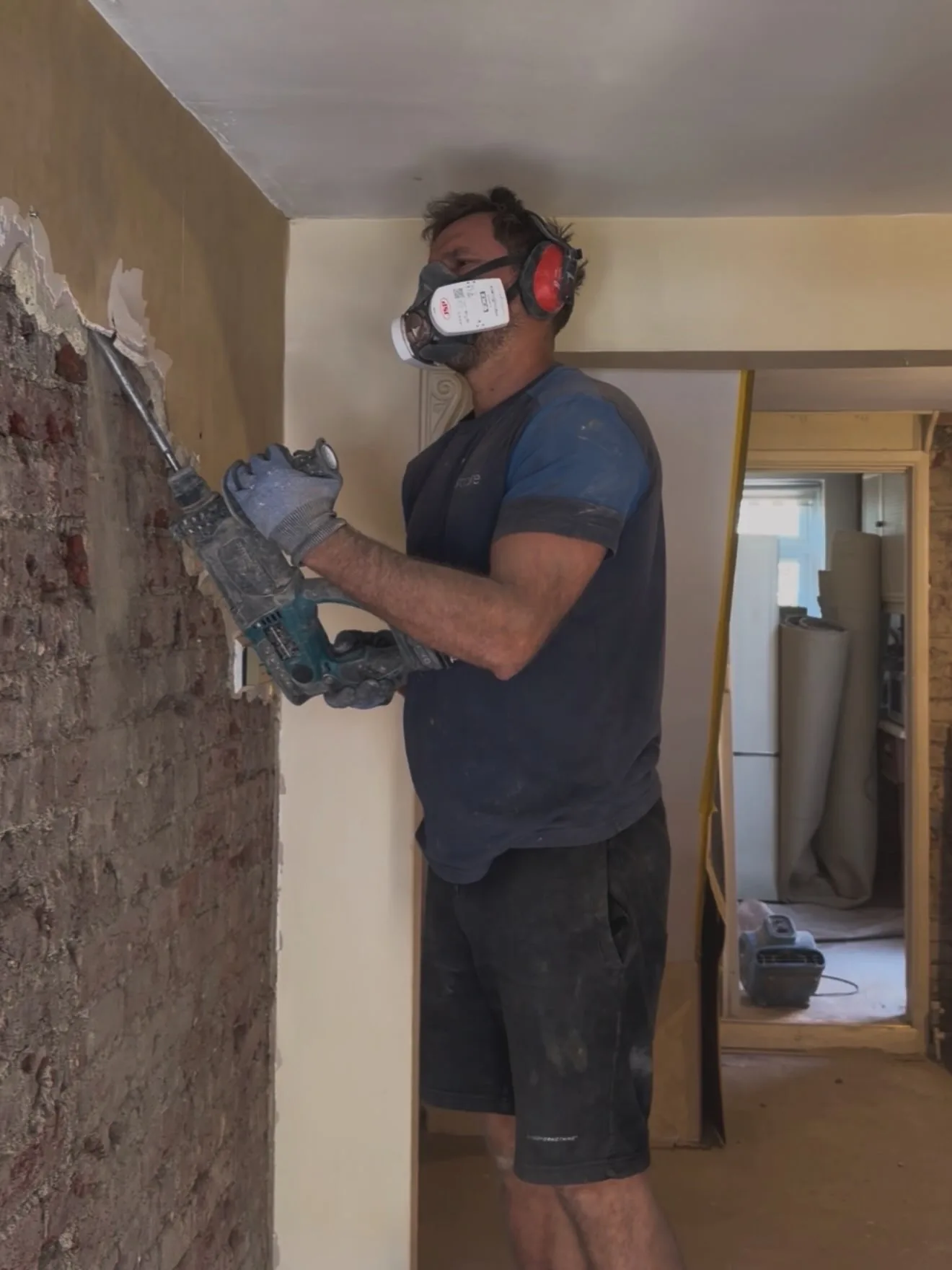
Contaminated plaster is cut out to the extent the evidence requires, taken sufficiently above and beyond the visible damage to remove the salt-laden material rather than stopping at the stain.
The final extent is confirmed on site as the plaster comes off, because contamination is not always visible from the face. - 3
Prepare the background
Joints raked out where necessary, loose material removed, and the masonry inspected properly now that it is exposed — this is when previously concealed defects are often found.
- 4
Apply the right system
A salt-resisting render and plaster specification, a lime-based system where the construction calls for it, or a membrane and dry lining approach where the wall cannot be expected to dry.
- Cement-based salt-retardant render and skim
- Lime-based systems for traditionally built walls
- Membrane lining where residual dampness will remain
- Insulated board where surface temperature is also a problem
- 5
Dry, then decorate
A stated drying period, breathable decoration for the first finish, and written advice on when a normal decorative scheme can follow.
Related work
Related work and reading
Rising damp assessments
Capillary moisture, damp-proof courses, bridging and salt contamination assessed on the evidence rather than a meter reading.
Damp proofing
Why damp proofing is not one treatment, and how the right remedial specification follows the diagnosis.
Damp surveys and moisture investigations
What a professional damp investigation covers, what the instruments can and cannot establish, and what your written report contains.
Internal wall insulation
Cold solid walls warmed correctly, with the condensation risk assessed instead of ignored.
When damaged plaster may need replacement
How to tell whether plaster genuinely needs replacing.
How long damp walls may take to dry
Realistic drying times for solid masonry, and why decoration should wait.
Where we work
Damp-resistant plastering across Bedfordshire, Northamptonshire and Cambridgeshire
Damp-resistant plastering is carried out across our operating area. Choose your county or town to see the work we do locally, the postcode districts we cover and how to arrange an inspection.
0% INTEREST. NO FEES.
Spread the cost of your remedial works.
Pay 40% upfront and spread the balance over three or six monthly instalments.
Available on eligible remedial works, subject to assessment and written agreement.
Frequently asked questions
Next step
Not sure which inspection you need? Start with a few questions.
Tell us what you are seeing and we will set out what is likely, what is uncertain and which inspection would answer the question. Speak to us on 0333 335 6152 if you would rather talk it through.