
Art gallery · St Albans
ISO-Therm internal wall insulation to an art gallery
- Agreed approach
- ISO-Therm internal wall insulation installed throughout the gallery, fitted from scaffold and finished ready for decoration.
If you own or manage a property in Thrapston and have noticed damp patches, mould growth, a musty smell or deteriorating timber, it is worth understanding what is causing it before spending money on remedial work. Procure Group Ltd carries out thorough damp investigations, mould and condensation assessments, timber decay and woodworm inspections, and below-ground damp protection across Thrapston and the surrounding part of Northamptonshire. We confirm the cause through inspection rather than assuming it, and we explain our findings plainly so you can make an informed decision about what to do next.



What we investigate
Any one of these symptoms can have several different causes, and the right remedy depends entirely on which one it is. That is what a survey establishes.
Staining at low level or around a specific point on a wall or ceiling.
Black, green or grey growth on walls, ceilings, sealant, window reveals or behind furniture.
A persistent smell, often in a cupboard, wardrobe or unused room, sometimes before anything is visible.
Blistering, salting, crumbling plaster or wallpaper lifting away from the wall.
Water on glass and frames in the morning, and mould appearing on cold surfaces.
Damp appearing during or after rain, frequently linked to rainwater goods or pointing.
Low-level dampness that may be rising damp, or may be one of several other causes.
Soft or crumbling timber, fungal growth, exit holes or springy floors.
Plumbing, heating or drainage leaks that show up some distance from the source.
Rooms that feel humid, cold spots at reveals and lintels, and extract fans that do not clear steam.
Damp, salting or water ingress at or just below external ground level.
What we are asked for
Each of these is a different problem with a different remedy. Which one applies depends on what the readings and the building show.
An evidence-led investigation of what is making the wall wet, with readings and findings you can act on.
Where a damp-proof course has genuinely failed, the appropriate remedial specification for the wall in question.
Professional remediation of the contamination, and control of the moisture conditions behind it.
Humidity, ventilation and surface temperature measured before any equipment is recommended.
Damp at or just below external ground level investigated, with localised protection where remediation calls for it. We do not install basement or cellar waterproofing.
Services
Each service below links to the full national service page, where the investigation, the treatment options and the circumstances in which it is not appropriate are set out in detail.
Damp
A structured investigation to establish the likely cause of dampness before any remedial work is recommended.
Damp
Careful assessment of low-level dampness, which is frequently caused by something other than rising damp.
Damp
Investigation of moisture entering through walls, roofs, openings and rainwater goods.
Surveys
Mould & condensation
Assessment of moisture production, ventilation, heating and insulation to reduce surface condensation.
Mould & condensation
Treating the mould is only part of the solution. We investigate why it developed in the first place, then remediate the contamination and control the conditions that caused it.
Timber
Assessment and treatment of structural timbers affected by moisture, decay or insect attack.
Timber
Establishing whether insect activity is current before recommending any treatment.
Timber
Identifying and repairing timber decay caused by sustained high moisture content.
Timber
Careful investigation of suspected dry rot, which can extend beyond visibly damp timber.
Repairs & finishes
Replastering specifications appropriate to walls affected by dampness or salt contamination.
Repairs & finishes
Repairs to the external fabric that address the source of moisture entry.
Repairs & finishes
Drying, repair and reinstatement following leaks, escapes of water or flooding.
Repairs & finishes
Insulation of solid walls with careful attention to moisture risk and detailing.
Our work
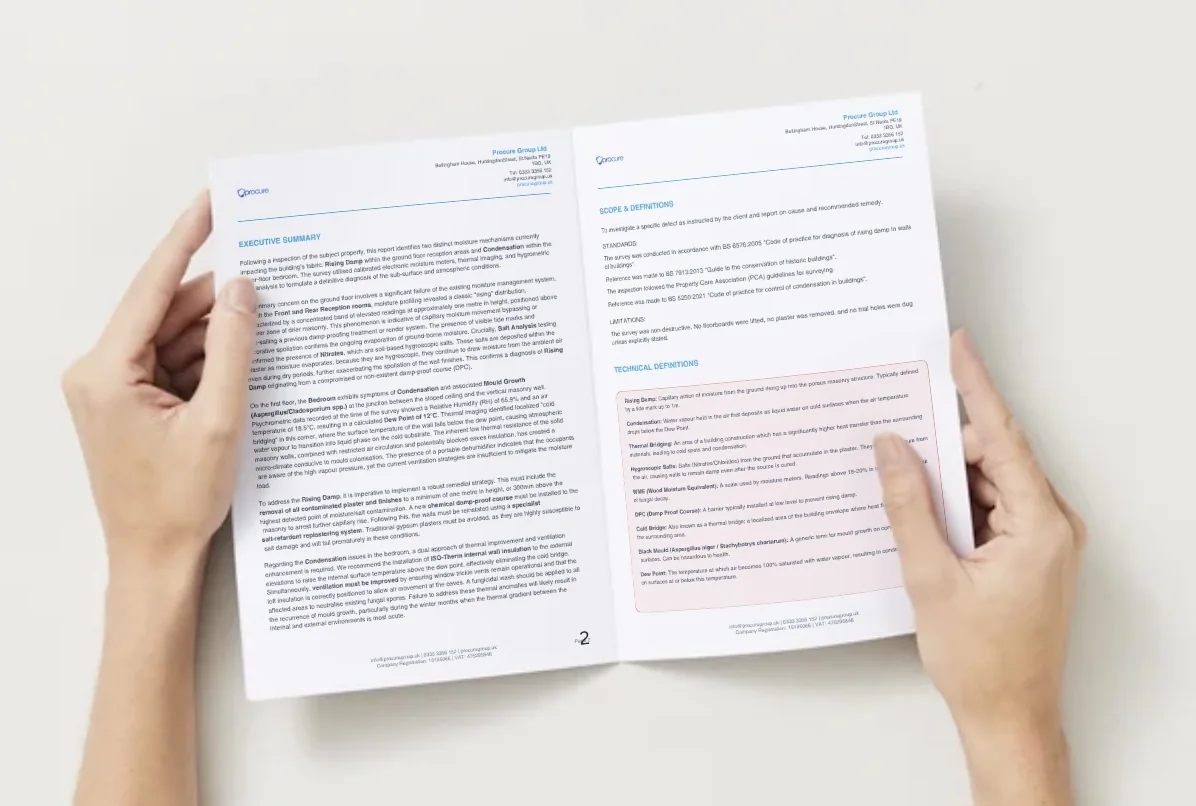
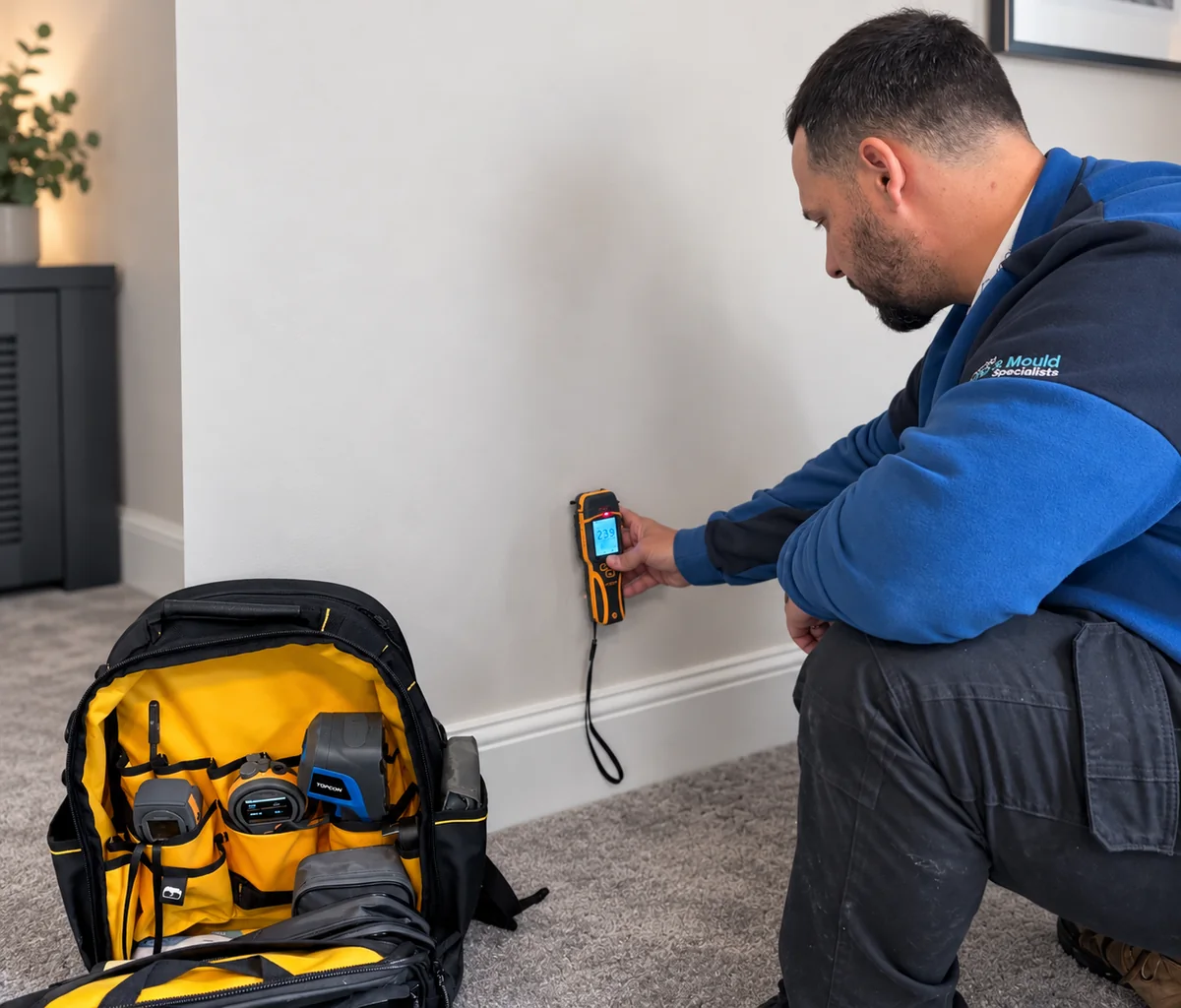
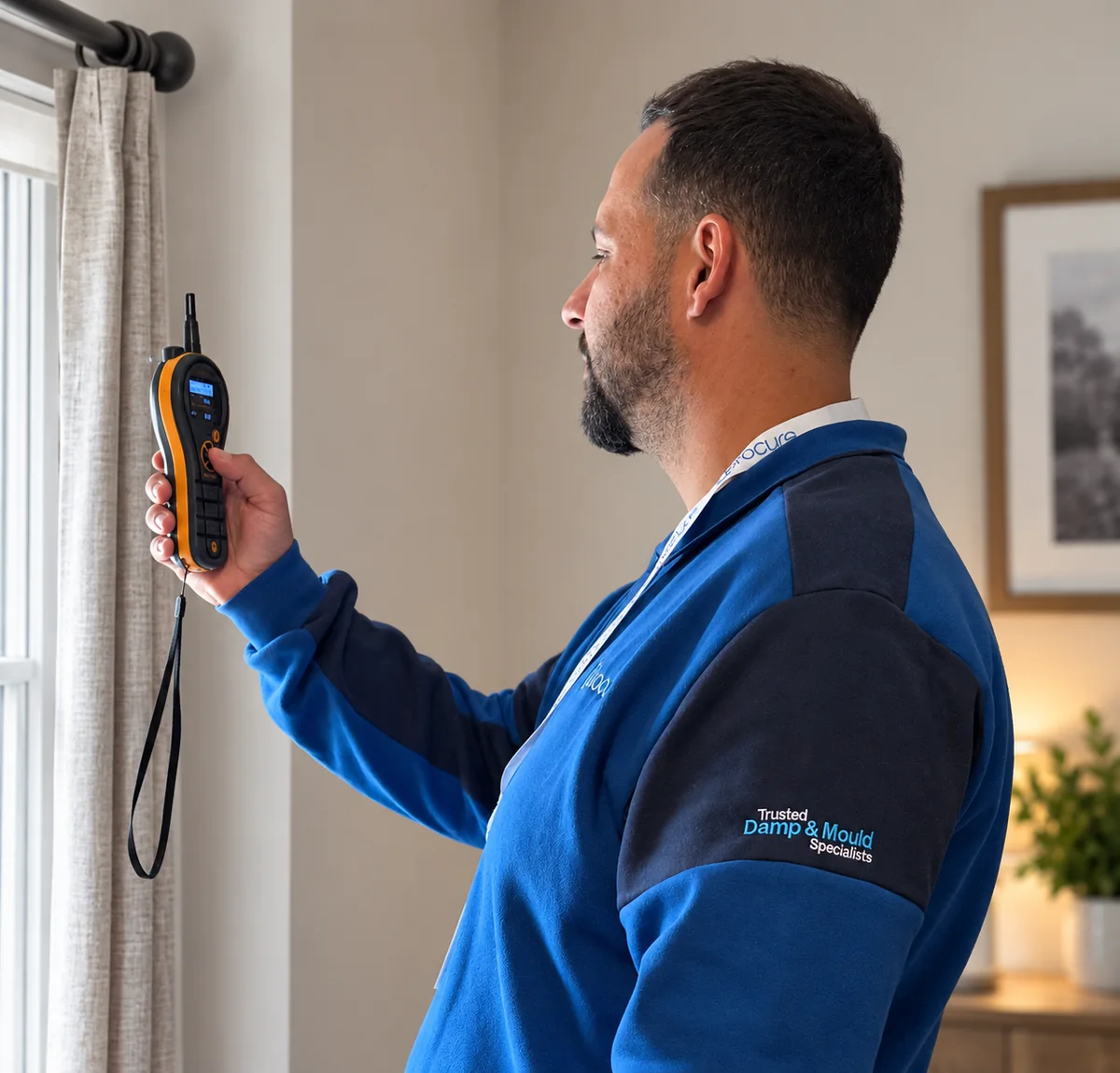
Photographs from Procure Group projects. Work of this kind is carried out across the area, so none is presented as a property at a particular address unless the caption says so.
Local property context
Different construction types behave differently when they get wet, so the approach is matched to the building in front of us.
Thrapston sits in the Nene valley in Northamptonshire, and the proximity of low-lying ground to the river has a bearing on the moisture conditions that older properties in the town can experience. Stone and brick-built cottages and terraced houses dating from the Victorian and Edwardian periods are common in and around the older parts of the town. Many were constructed without a damp-proof course, or with a slate or engineering-brick course that has since deteriorated or become bridged by raised external ground levels, rendering floors or injudicious landscaping. Where that happens, moisture can travel upward through the masonry in a pattern that is often mistaken for other causes.
Interwar semi-detached houses and earlier post-war housing in Thrapston were generally built with cavity walls, which provide some protection against driven rain penetrating to the inner leaf, provided the cavity remains clear. Over time, however, cavities can accumulate debris or ill-placed insulation that creates a moisture bridge, and outer leaf pointing or render can deteriorate to the point where rainwater enters more directly. Penetrating damp of this kind tends to present as damp patches that are closely related to weather events rather than following the horizontal line associated with rising damp, though both can occur in the same property.
Condensation and mould growth have become more common in properties of all ages following improvements to thermal insulation and window replacement. Double-glazed sealed units and added insulation reduce heat loss but also restrict the passive air movement that previously carried moisture out of the building. In properties where occupancy patterns produce significant moisture from cooking, bathing or drying laundry, that vapour condenses on cooler surfaces, particularly in corners, behind furniture and on north-facing walls. Mould follows where condensation is persistent. Correctly distinguishing condensation-related mould from mould caused by structural dampness requires careful assessment rather than a visual inspection alone.
Timber within older Thrapston properties, particularly ground-floor joists, sub-floor structures and any timbers built into external walls, can be vulnerable to wood-rot and insect attack when moisture levels remain elevated over a long period. Woodworm activity is often discovered during a damp investigation when access is gained to roof voids or sub-floor spaces. A methodical inspection establishes which of these mechanisms is active, how extensive the affected area is, and what the most appropriate course of remedial action would be.
Our approach
The purpose of a survey is to identify the underlying cause of the moisture, not to justify a particular treatment.
Transparent pricing
A Damp Proofing Quote Assessment is £114 plus VAT. The fee can be deducted from the final invoice if eligible remedial works proceed, subject to the agreed terms. Other inspection types are priced according to their scope.
Inspection requirements vary between properties, so larger, more complex or commercial buildings are priced according to their scope. You will be told the fee before the visit is confirmed — there are no charges added afterwards.
0% INTEREST. NO FEES.
Spread the cost of your remedial works.
Pay 40% upfront and spread the balance over three or six monthly instalments.
Available on eligible remedial works, subject to assessment and written agreement.
Online tools
Answer a few simple questions, upload photographs and receive an initial summary of possible causes and the type of survey that may be appropriate.
Upload an existing damp report, building survey, RICS report or property inspection document for an initial AI-assisted summary and recommended next steps.
Send us the details and photographs of the problem and our team will price the work and put it in writing.
Regional project example
We do not have a published project in Thrapston yet, so this example is from elsewhere in the area we cover. We will not present work as local when it is not.
Art gallery · St Albans
Verified customer reviews
“The guys were really polite and friendly, super professional, they did a perfect job but they didn't hang around either, no time wasted! They kept me updated every single step of the job, like letting me know when they were going outside whilst the plaster was drying. I really appreciated the communication. The lads tidied up really nice inside and the boss came back the same day and took all the rubbish away and swept up. Literally couldn't ask for more :)”
“The team at Procure, Cassie and Callum in particular, were both incredibly professional and incredibly kind throughout the whole process: from booking the survey to completing the works, they were flexible, understanding and reliable. They showed good humour while also being experienced and knowledgable, they took their time to explain everything while still making us feel that everything was on our terms. I can't think of a better contractor, I can wholeheartedly recommend.”
“5 Star all the way. Procure are simply the best trade services company we have ever dealt with. From the beginning of the process, Callum (the owner), his office staff and all involved have been courteous, professional and diligent in all communication & contact. We were buying a new house with multiple damp issues. Callum surveyed and advised the best course of action, even recommending cheaper options of repair, where more costly alternatives could easily have been offered. The two days he was on site along with his brother, were very easy. Both were very friendly, polite and most importantly diligent in their work. You could see they took pride in the quality of what they did, going above and beyond what was quoted for, leaving the place as clean as possible behind them. We would have no hesitation recommending Callum and the Procure Team. Book with confidence here”
Every review is from a customer whose work we completed, published as it was written. Read all of our reviews.
Questions
A damp survey involves a systematic inspection of the property using calibrated moisture meters, a thermal imaging camera where appropriate, and visual examination of the fabric of the building inside and out. We look at ground levels, drainage, pointing, render, gutters and downpipes externally, and at wall bases, floor junctions, plasterwork and any accessible sub-floor or roof spaces internally. The aim is to confirm the cause of dampness rather than record only the symptom, so that any remedial work addresses the actual problem.
It occurs in properties that genuinely lack a damp-proof course or have one that has failed or been bypassed. Victorian and Edwardian stone and brick buildings in Thrapston were not always built with effective damp-proof courses, and where external ground levels have been raised over the years the risk increases. That said, rising damp is frequently confused with penetrating damp or condensation, which is why inspection using appropriate equipment matters. We do not diagnose rising damp without the moisture profile and readings to support that conclusion.
Yes. Modern energy-efficiency measures reduce air infiltration, which is beneficial for heating costs but means moisture produced by occupants has fewer routes to escape. Properties that have had windows replaced or insulation added without corresponding improvements to airflow are particularly susceptible. The mould itself is a symptom of persistent surface condensation. We assess airflow, thermal bridging, occupancy patterns and surface temperatures as part of a condensation assessment to give a clear picture of what is driving the problem.
We do. Timber decay and woodworm inspections form part of our service across the NN14 area, including Thrapston and nearby towns such as Oundle and Raunds. We check structural and non-structural timbers for signs of wet rot, dry rot and insect infestation, and we assess the moisture conditions that are allowing decay to progress. Identifying and resolving the moisture source is as important as treating the affected timber, since timber in dry conditions does not decay and most woodworm species cannot complete their life cycle without adequate moisture.
Related reading
Written by our surveyors, on the questions we are asked most often.
Nearby
We also work in Oundle, Raunds, Desborough, Rothwell, Kettering and Burton Latimer. For everywhere else we cover, see our Northamptonshire service area.
Written and last reviewed by the Procure Group survey team on .
Accredited & certified
Specialist qualifications in damp, timber and mould, independently assessed health and safety, and carded operatives on every site.
Fully insured, including professional indemnity.
PCA Qualified Technician

CHAS Accredited Contractor

UKAME Accredited

Dewpoint Professional

Construction Skills Certification Scheme
Blue & Gold Skilled Workers
Trade qualifications held
NVQ Level 2
Damp-proofing & wood preservation
NVQ Level 3
Insulation & building treatments

HS&E tested
Health, safety & environment
Next step
Book an inspection, ask for a callback, or use one of the online tools first. Whichever suits you — there is no obligation either way.
Tell us what you are seeing and we will come back to you. Your enquiry is tagged to Thrapston so the right surveyor picks it up.
Your cookie choices
Essential cookies keep the site working. With your permission we also measure how many people book after seeing one of our adverts. We never profile you or sell your details. Cookie Policy · Privacy Policy