
Art gallery · St Albans
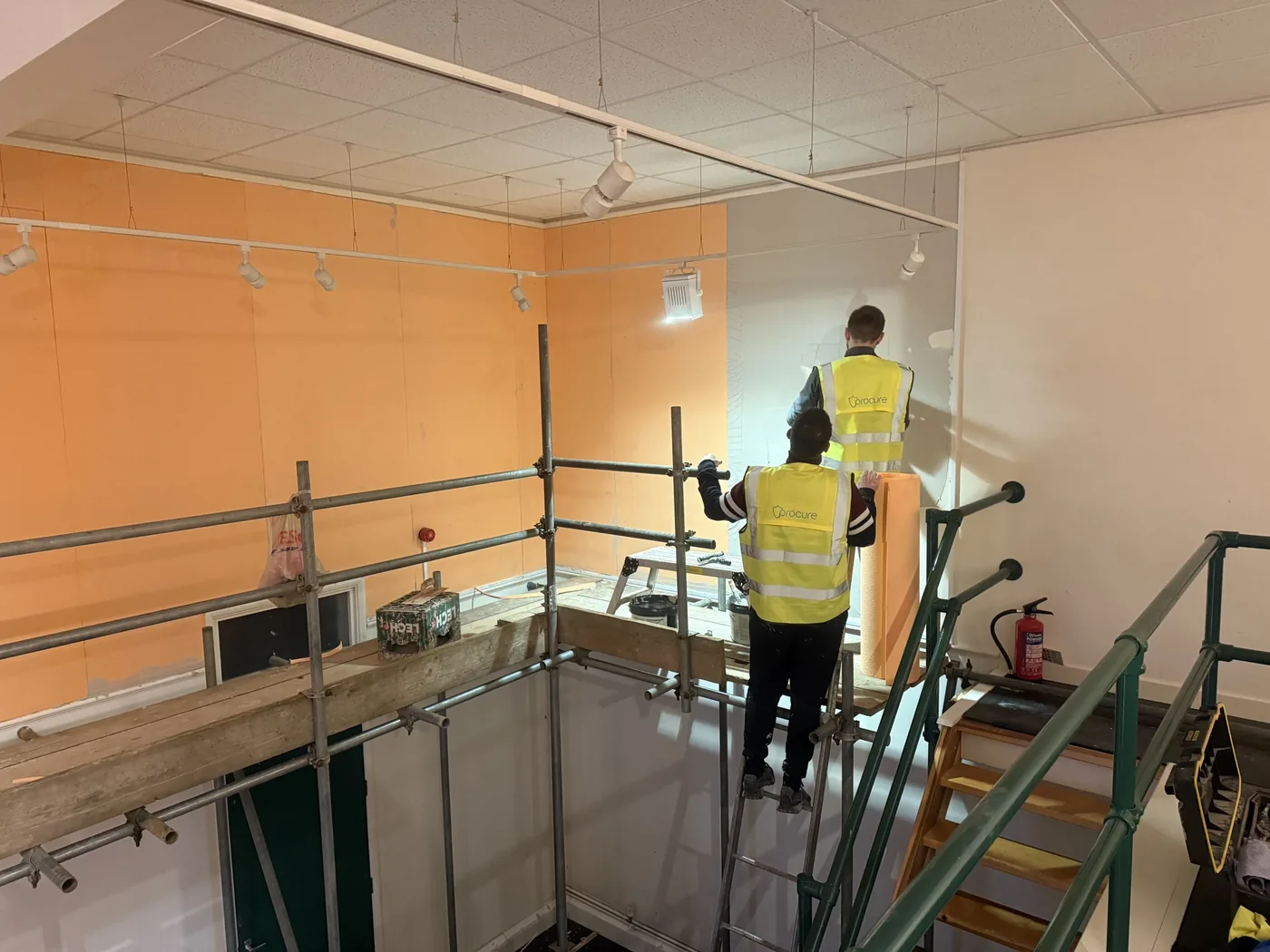
ISO-Therm internal wall insulation to an art gallery
- Agreed approach
- ISO-Therm internal wall insulation installed throughout the gallery, fitted from scaffold and finished ready for decoration.
Newport Pagnell mixes an old market town centre with several generations of later housing, and the right diagnosis depends on knowing which you are standing in. Procure Group Ltd carries out damp investigations, mould and condensation assessments, timber and woodworm inspections and below-ground damp protection surveys across Newport Pagnell, Tickford End, Green End and the MK16 district. Every recommendation follows an inspection, and we put the evidence in writing so you can see why a course of action is or is not justified.



What we investigate
Any one of these symptoms can have several different causes, and the right remedy depends entirely on which one it is. That is what a survey establishes.
Staining at low level or around a specific point on a wall or ceiling.
Black, green or grey growth on walls, ceilings, sealant, window reveals or behind furniture.
A persistent smell, often in a cupboard, wardrobe or unused room, sometimes before anything is visible.
Blistering, salting, crumbling plaster or wallpaper lifting away from the wall.
Water on glass and frames in the morning, and mould appearing on cold surfaces.
Damp appearing during or after rain, frequently linked to rainwater goods or pointing.
Low-level dampness that may be rising damp, or may be one of several other causes.
Soft or crumbling timber, fungal growth, exit holes or springy floors.
Plumbing, heating or drainage leaks that show up some distance from the source.
Rooms that feel humid, cold spots at reveals and lintels, and extract fans that do not clear steam.
Damp, salting or water ingress at or just below external ground level.
What we are asked for
Each of these is a different problem with a different remedy. Which one applies depends on what the readings and the building show.
An evidence-led investigation of what is making the wall wet, with readings and findings you can act on.
Where a damp-proof course has genuinely failed, the appropriate remedial specification for the wall in question.
Professional remediation of the contamination, and control of the moisture conditions behind it.
Humidity, ventilation and surface temperature measured before any equipment is recommended.
Damp at or just below external ground level investigated, with localised protection where remediation calls for it. We do not install basement or cellar waterproofing.
Services
Each service below links to the full national service page, where the investigation, the treatment options and the circumstances in which it is not appropriate are set out in detail.
Damp
A structured investigation to establish the likely cause of dampness before any remedial work is recommended.
Damp
Careful assessment of low-level dampness, which is frequently caused by something other than rising damp.
Damp
Investigation of moisture entering through walls, roofs, openings and rainwater goods.
Surveys
Mould & condensation
Assessment of moisture production, ventilation, heating and insulation to reduce surface condensation.
Mould & condensation
Treating the mould is only part of the solution. We investigate why it developed in the first place, then remediate the contamination and control the conditions that caused it.
Timber
Assessment and treatment of structural timbers affected by moisture, decay or insect attack.
Timber
Establishing whether insect activity is current before recommending any treatment.
Timber
Identifying and repairing timber decay caused by sustained high moisture content.
Timber
Careful investigation of suspected dry rot, which can extend beyond visibly damp timber.
Repairs & finishes
Replastering specifications appropriate to walls affected by dampness or salt contamination.
Repairs & finishes
Repairs to the external fabric that address the source of moisture entry.
Repairs & finishes
Drying, repair and reinstatement following leaks, escapes of water or flooding.
Repairs & finishes
Insulation of solid walls with careful attention to moisture risk and detailing.
Our work
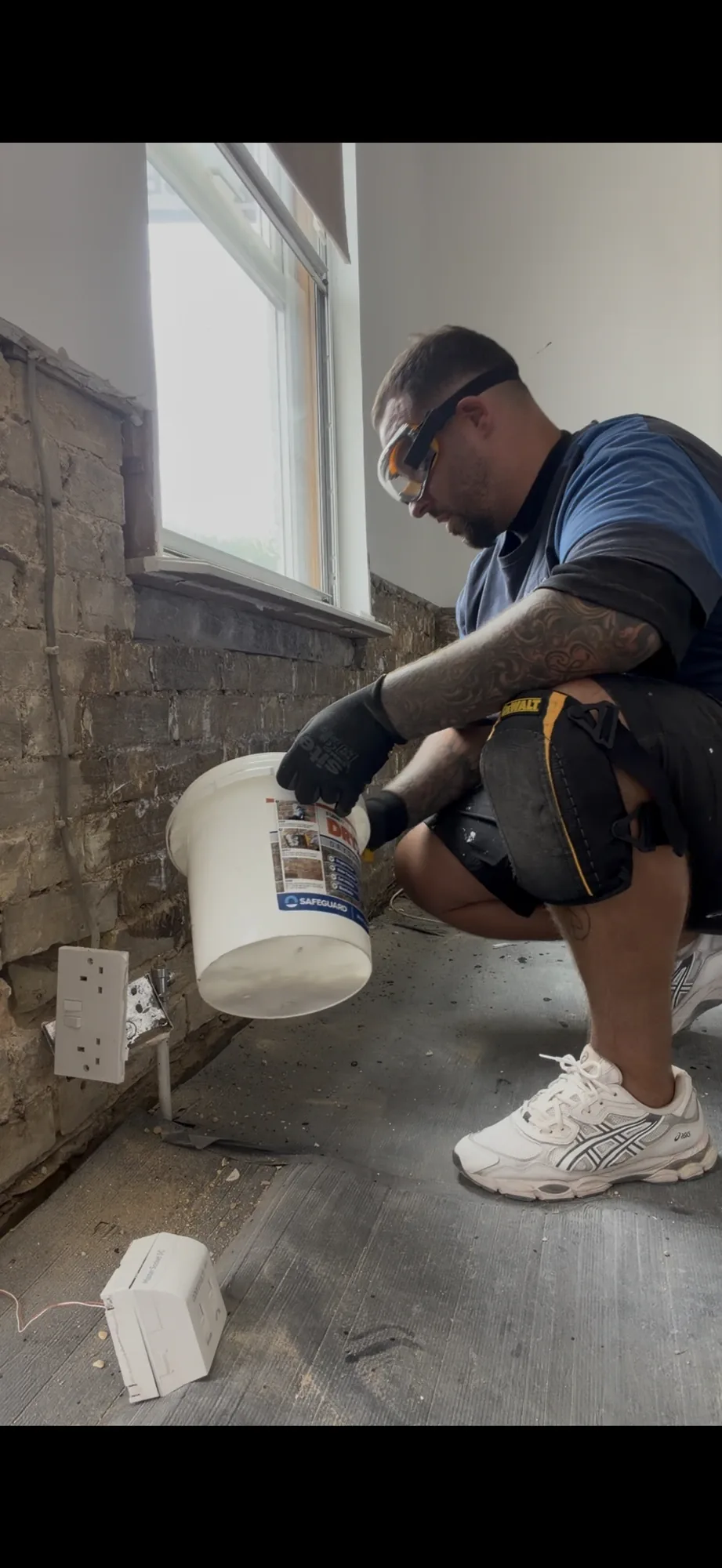
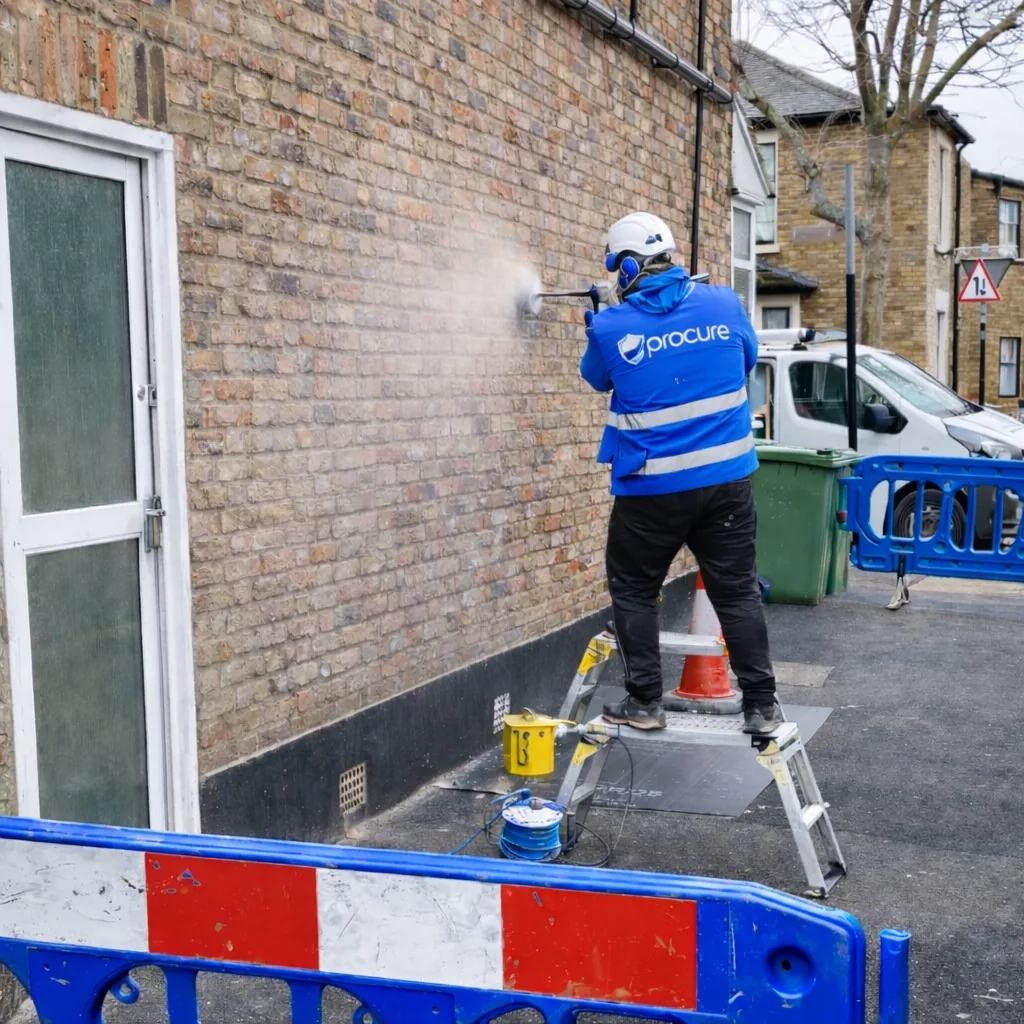
Photographs from Procure Group projects. Work of this kind is carried out across the area, so none is presented as a property at a particular address unless the caption says so.
Local property context
Different construction types behave differently when they get wet, so the approach is matched to the building in front of us.
The older streets around the High Street, Silver Street and St John Street contain solid-walled brick and stone properties, some with earlier timber framing, built long before damp-proof courses existed. In buildings of this kind the fabric needs to dry outwards, and the most frequent causes of persistent damp are the things that prevent it: cement render or hard pointing on soft brick, modern impermeable internal finishes, ground and pavement levels that have crept above internal floor level, and rainwater discharging against wall bases. Where a chemical damp-proof course has been retrofitted, it is often the bridging rather than the course itself that has allowed the problem to return.
The town sits where the River Lovat meets the Great Ouse, and properties on the lower ground towards the rivers and the old mill areas can be affected by a high water table and by surface water after prolonged rain. A below-ground survey establishes where water is entering, at what rate and under what conditions, before any localised damp protection is specified, because the wrong system in the wrong place simply moves the problem.
Interwar and post-war expansion, and the later estates built as Milton Keynes grew, brought cavity-walled housing to Tickford End, Green End and the northern edges of the town. Cavity walls handle driven rain well until the cavity is bridged by mortar debris, slumped retrofitted insulation, or a wall tie and lintel detail that channels water inward. In these houses, and particularly in properties where glazing and insulation have been upgraded without any improvement in moisture removal, condensation and mould are the more likely explanation for a damp patch, and treating them as rising damp achieves nothing.
A timber inspection is part of a proper assessment in a town with this much older stock. Embedded joist ends and wall plates in solid walls, suspended ground floors whose airbricks have been blocked by patios or extensions, and roof timbers affected by long-standing leaks are the recurring findings. Old furniture beetle flight holes are extremely common in Victorian and earlier softwood and very often represent activity that ended decades ago. We establish whether infestation is live, whether decay is wet or dry rot, and whether anything structural is affected, because those three answers determine whether treatment is needed at all.
Our approach
The purpose of a survey is to identify the underlying cause of the moisture, not to justify a particular treatment.
Transparent pricing
A Damp Proofing Quote Assessment is £114 plus VAT. The fee can be deducted from the final invoice if eligible remedial works proceed, subject to the agreed terms. Other inspection types are priced according to their scope.
Inspection requirements vary between properties, so larger, more complex or commercial buildings are priced according to their scope. You will be told the fee before the visit is confirmed — there are no charges added afterwards.
Online tools
Answer a few simple questions, upload photographs and receive an initial summary of possible causes and the type of survey that may be appropriate.
Upload an existing damp report, building survey, RICS report or property inspection document for an initial AI-assisted summary and recommended next steps.
Send us the details and photographs of the problem and our team will price the work and put it in writing.
Regional project example
We do not have a published project in Newport Pagnell yet, so this example is from elsewhere in the area we cover. We will not present work as local when it is not.
Art gallery · St Albans
Verified customer reviews
These reviews are from customers elsewhere in the region rather than this town. We publish them as they were given.
Questions
A Damp Proofing Quote Assessment is £114 plus VAT and can be deducted from the final invoice if eligible remedial works proceed, subject to the agreed terms; other inspection types are priced to their scope. The visit includes internal and external inspection, moisture readings across the affected areas, assessment of ground levels, rainwater goods and airflow provision, and a written record of the findings with recommendations.
It is much less likely than in a solid-walled property. In cavity-walled houses of that period we more often find bridged cavities, defective external details, plumbing leaks or condensation. The pattern, the height, the timing through the year and the readings across different walls usually make the difference clear, and that is what the investigation is for.
Yes. We work throughout the MK16 district and the wider Milton Keynes area, including the surrounding villages, as well as Bedfordshire, Cambridgeshire, Hertfordshire, Northamptonshire and Peterborough.
Not necessarily. Flight holes show that beetle activity happened at some point; they do not show that it is continuing. We look for fresh bore dust, the condition and colour of the holes and whether the timber's moisture content is high enough to sustain activity. Where infestation is not live, treatment is unnecessary, and we say so.
Related reading
Written by our surveyors, on the questions we are asked most often.
Nearby
We also work in Wolverton, Olney, Stony Stratford, Woburn Sands and Bletchley. For everywhere else we cover, see our Milton Keynes service area.
Written and last reviewed by the Procure Group survey team on .
Next step
Book an inspection, ask for a callback, or use one of the online tools first. Whichever suits you — there is no obligation either way.
Tell us what you are seeing and we will come back to you. Your enquiry is tagged to Newport Pagnell so the right surveyor picks it up.
Your cookie choices
We use essential cookies to make this website work. With your permission we also use Google Ads cookies to measure how many people book an inspection after seeing one of our adverts. We do not use cookies to profile you or sell your details, and you can change your mind at any time. Cookie Policy · Privacy Policy