
Art gallery · St Albans
ISO-Therm internal wall insulation to an art gallery
- Agreed approach
- ISO-Therm internal wall insulation installed throughout the gallery, fitted from scaffold and finished ready for decoration.
If you own or manage a property in Kempston and have noticed damp patches, persistent mould, a musty smell or signs of timber decay, the first step is understanding what is actually causing the problem. Procure Group Ltd carries out thorough damp surveys across MK42 and the wider Bedfordshire area, covering everything from rising damp and penetrating damp through to condensation-related mould growth and below-ground water ingress. We confirm the cause before recommending any remedial works, so you are not paying for treatments that do not address the real issue.



What we investigate
Any one of these symptoms can have several different causes, and the right remedy depends entirely on which one it is. That is what a survey establishes.
Staining at low level or around a specific point on a wall or ceiling.
Black, green or grey growth on walls, ceilings, sealant, window reveals or behind furniture.
A persistent smell, often in a cupboard, wardrobe or unused room, sometimes before anything is visible.
Blistering, salting, crumbling plaster or wallpaper lifting away from the wall.
Water on glass and frames in the morning, and mould appearing on cold surfaces.
Damp appearing during or after rain, frequently linked to rainwater goods or pointing.
Low-level dampness that may be rising damp, or may be one of several other causes.
Soft or crumbling timber, fungal growth, exit holes or springy floors.
Plumbing, heating or drainage leaks that show up some distance from the source.
Rooms that feel humid, cold spots at reveals and lintels, and extract fans that do not clear steam.
Damp, salting or water ingress at or just below external ground level.
What we are asked for
Each of these is a different problem with a different remedy. Which one applies depends on what the readings and the building show.
An evidence-led investigation of what is making the wall wet, with readings and findings you can act on.
Where a damp-proof course has genuinely failed, the appropriate remedial specification for the wall in question.
Professional remediation of the contamination, and control of the moisture conditions behind it.
Humidity, ventilation and surface temperature measured before any equipment is recommended.
Damp at or just below external ground level investigated, with localised protection where remediation calls for it. We do not install basement or cellar waterproofing.
Services
Each service below links to the full national service page, where the investigation, the treatment options and the circumstances in which it is not appropriate are set out in detail.
Damp
A structured investigation to establish the likely cause of dampness before any remedial work is recommended.
Damp
Careful assessment of low-level dampness, which is frequently caused by something other than rising damp.
Damp
Investigation of moisture entering through walls, roofs, openings and rainwater goods.
Surveys
Mould & condensation
Assessment of moisture production, ventilation, heating and insulation to reduce surface condensation.
Mould & condensation
Treating the mould is only part of the solution. We investigate why it developed in the first place, then remediate the contamination and control the conditions that caused it.
Timber
Assessment and treatment of structural timbers affected by moisture, decay or insect attack.
Timber
Establishing whether insect activity is current before recommending any treatment.
Timber
Identifying and repairing timber decay caused by sustained high moisture content.
Timber
Careful investigation of suspected dry rot, which can extend beyond visibly damp timber.
Repairs & finishes
Replastering specifications appropriate to walls affected by dampness or salt contamination.
Repairs & finishes
Repairs to the external fabric that address the source of moisture entry.
Repairs & finishes
Drying, repair and reinstatement following leaks, escapes of water or flooding.
Repairs & finishes
Insulation of solid walls with careful attention to moisture risk and detailing.
Our work
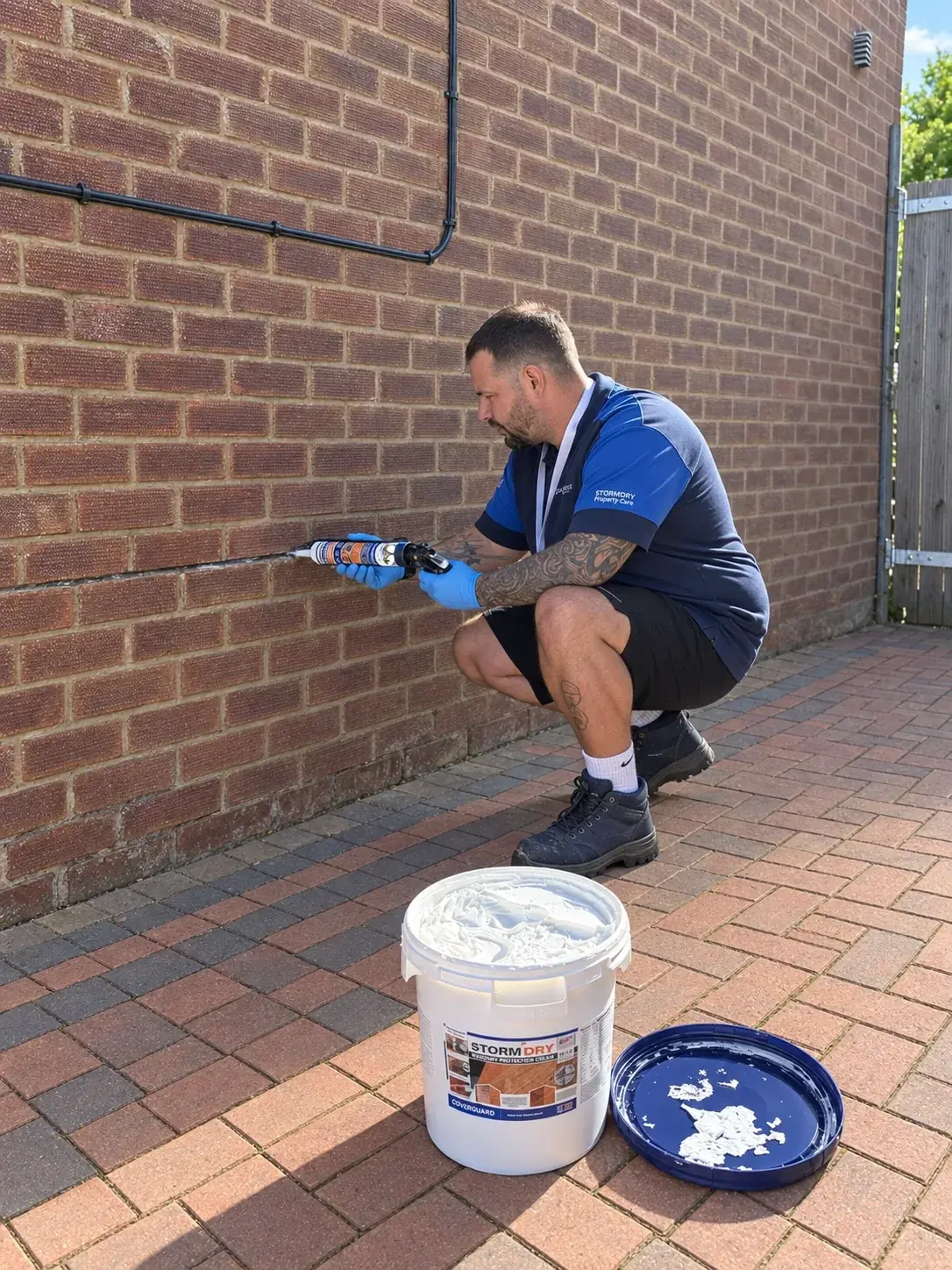
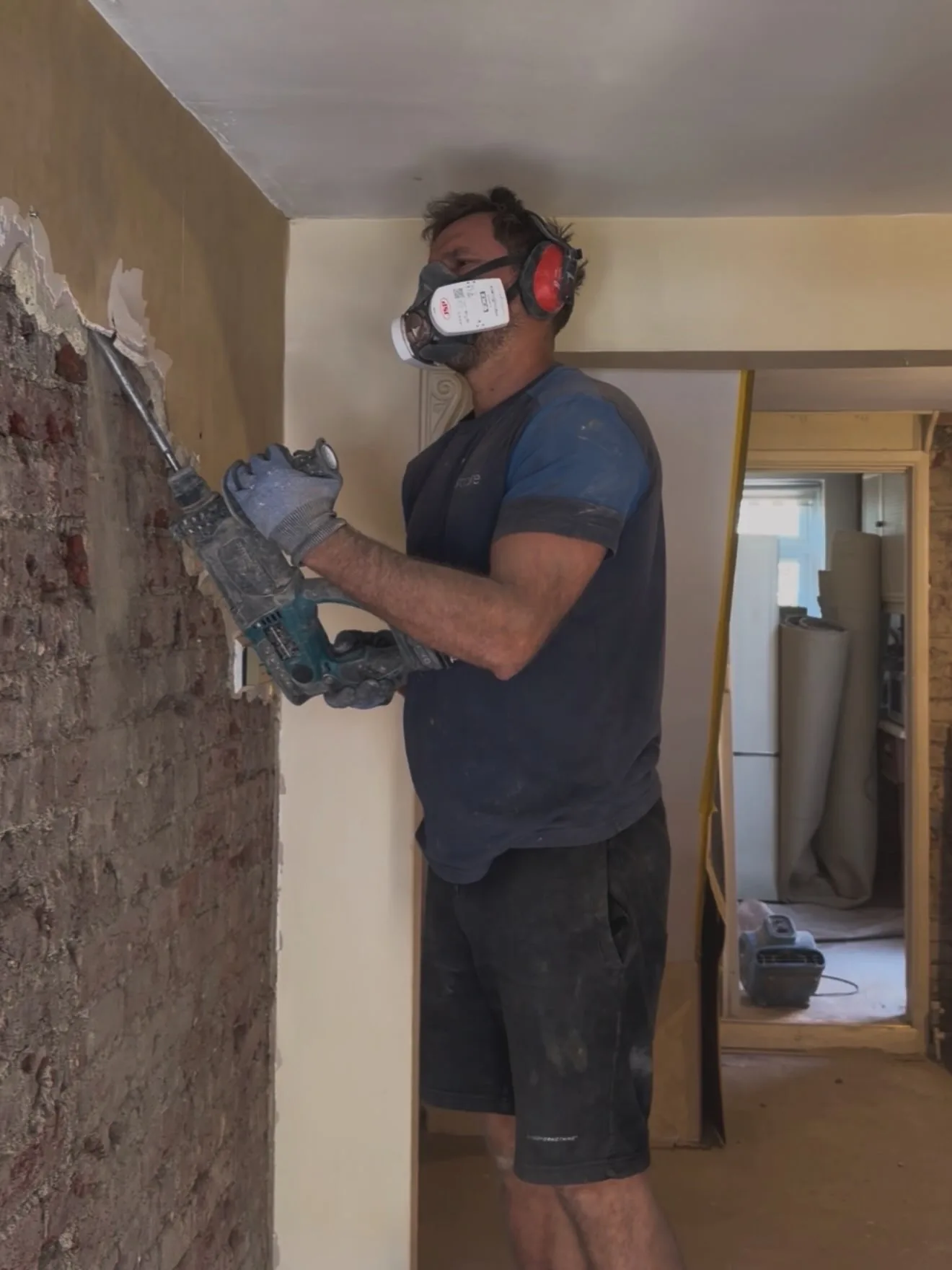
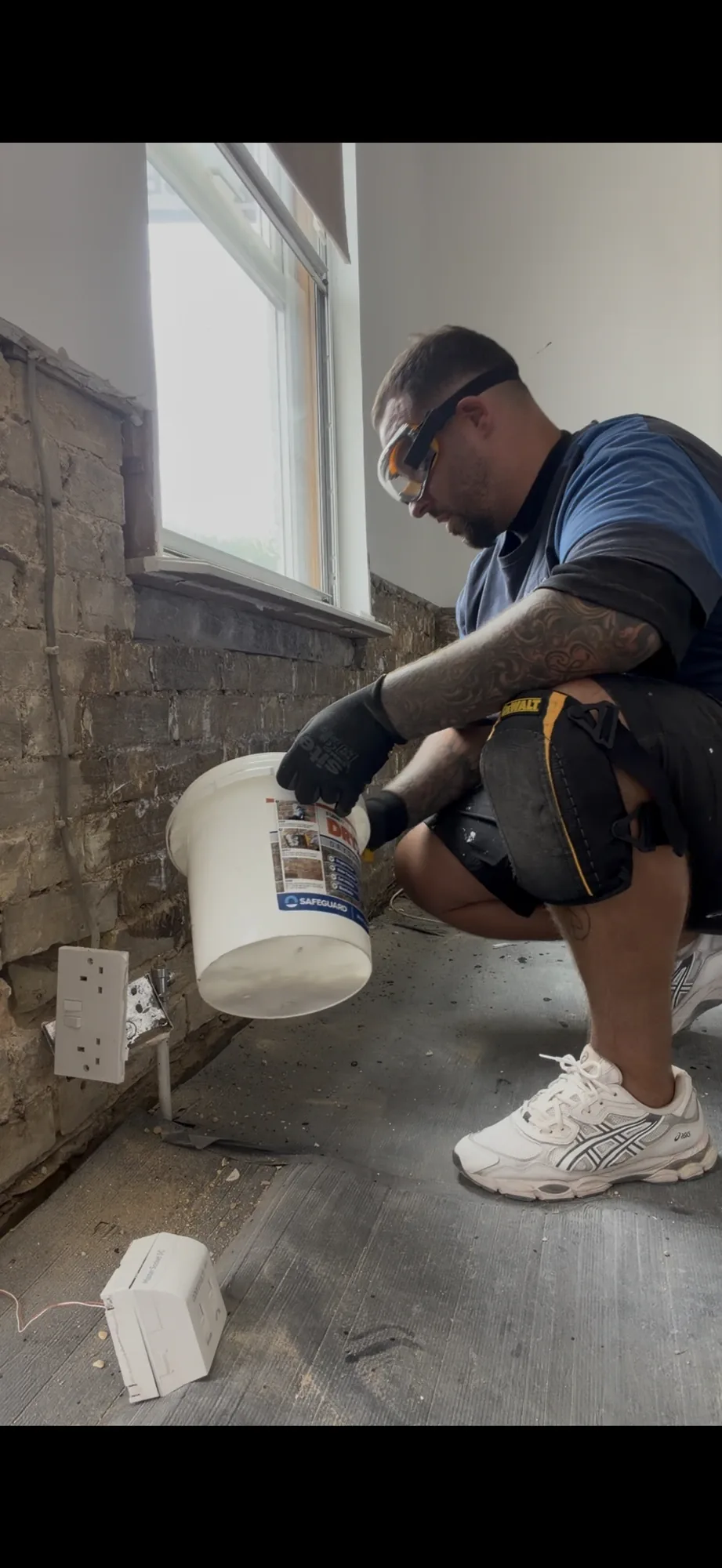
Photographs from Procure Group projects. Work of this kind is carried out across the area, so none is presented as a property at a particular address unless the caption says so.
Local property context
Different construction types behave differently when they get wet, so the approach is matched to the building in front of us.
Kempston sits to the west of Bedford on the River Great Ouse, and the town's housing stock reflects several distinct periods of development. The older core contains Victorian and Edwardian terraced properties built with solid brick walls and no modern damp-proof course, or with a damp-proof course that has deteriorated or become bridged by raised external ground levels or poorly applied render. In these houses, rising damp can track moisture from the ground up through masonry, producing characteristic tide marks on internal plaster, salting, and softening of skirting boards. An inspection establishes whether the damp-proof course is absent, failed, or simply overwhelmed by an external bridge.
Interwar semi-detached housing is common in parts of Kempston, and these properties introduced cavity-wall construction as standard. The cavity was designed to prevent moisture crossing from the outer leaf to the inner leaf, but cavities can be compromised over time by debris, mortar droppings or poorly installed insulation fill. Where the outer leaf suffers spalled brick faces or eroded pointing, water enters the cavity and can eventually reach the inner skin. Penetrating damp of this kind typically shows as damp patches that worsen after rainfall rather than presenting as the steady, low-level moisture associated with rising damp. A methodical survey distinguishes between the two.
Post-war council-built estates and the 1960s and 1970s housing that followed brought new construction methods, including system-built and early cavity designs with lower eaves and flat-roofed extensions. These properties can be prone to condensation and mould growth, particularly after subsequent upgrades such as double-glazed window replacements and added loft insulation, which reduce air exchange without a corresponding increase in mechanical airflow. Mould growth on north-facing walls, around window reveals and in poorly aired rooms is often reported as a damp problem but is principally an airflow and thermal bridging issue. Kempston properties of this era benefit from an assessment that separates condensation from structural moisture ingress.
Older cottages, converted farm buildings and any property in Kempston with a lower-ground-floor space introduce the additional risk of below-ground water. Where ground levels outside are higher than internal floor levels, hydrostatic pressure can drive water through masonry foundations or floor slabs. Long-term dampness in these spaces encourages timber decay in ground-floor joists and sub-floor timbers, and can create conditions where woodworm activity goes undetected for years.
Our below-ground work in Kempston sits inside damp remediation rather than alongside it. Procure Group does not undertake full basement or cellar waterproofing installations; our waterproofing work is limited to appropriate localised applications encountered as part of damp investigation and remediation. The diagnostic part of the job does not change, because the source of the water is established before anything is specified and an external correction is recommended wherever it will do the job.
Our approach
The purpose of a survey is to identify the underlying cause of the moisture, not to justify a particular treatment.
Transparent pricing
A Damp Proofing Quote Assessment is £114 plus VAT. The fee can be deducted from the final invoice if eligible remedial works proceed, subject to the agreed terms. Other inspection types are priced according to their scope.
Inspection requirements vary between properties, so larger, more complex or commercial buildings are priced according to their scope. You will be told the fee before the visit is confirmed — there are no charges added afterwards.
Online tools
Answer a few simple questions, upload photographs and receive an initial summary of possible causes and the type of survey that may be appropriate.
Upload an existing damp report, building survey, RICS report or property inspection document for an initial AI-assisted summary and recommended next steps.
Send us the details and photographs of the problem and our team will price the work and put it in writing.
Regional project example
We do not have a published project in Kempston yet, so this example is from elsewhere in the area we cover. We will not present work as local when it is not.
Art gallery · St Albans
Verified customer reviews
These reviews are from customers elsewhere in the region rather than this town. We publish them as they were given.
Questions
A surveyor visits the property and uses a combination of calibrated moisture meters, thermal observation and physical examination of the building fabric to map moisture levels. External features such as ground levels, drainage, pointing condition and render are checked alongside internal walls, floors, skirtings and ceilings. The aim is to identify the source and pathway of moisture rather than rely on a single reading. A written report sets out findings and, where works are warranted, explains what needs to be done and why.
Rising damp is more commonly associated with solid-wall Victorian and Edwardian construction, but it can affect later housing if the original damp-proof course has been bridged. Raised flowerbeds, re-rendered walls where render extends below the damp-proof course level, or accumulated debris against an external wall can all allow moisture to bypass the barrier. Whether a cavity-wall or solid-wall property in Kempston is affected by genuine rising damp, rather than another moisture source, is something the inspection is designed to establish.
Not always. Mould on internal surfaces, particularly in bedrooms, bathrooms or on north-facing walls, is frequently the result of condensation rather than moisture coming through the structure. Modern living habits generate substantial water vapour, and if airflow is restricted by sealed windows, draught-proofing or blocked vents, that vapour condenses on cold surfaces and feeds mould growth. An assessment looks at occupancy patterns, airflow provision and surface temperatures alongside moisture readings to determine whether the cause is condensation or structural damp.
Timber decay is not always visible in its early stages. Ground-floor joists in older Kempston properties can begin to rot or show fungal growth where they meet damp masonry, and the floor above may feel springy or soft before any discolouration is apparent. A timber inspection probes at-risk areas systematically, including sub-floor timbers, window frames, roof timbers and lintels, to assess whether decay is localised or widespread and whether woodworm activity is active or historic. This guides any decision about treatment or structural reinstatement.
Related reading
Written by our surveyors, on the questions we are asked most often.
Nearby
We also work in Bedford, Ampthill, Flitwick, Shefford, Biggleswade and Sandy. For everywhere else we cover, see our Bedfordshire service area.
Written and last reviewed by the Procure Group survey team on .
Next step
Book an inspection, ask for a callback, or use one of the online tools first. Whichever suits you — there is no obligation either way.
Tell us what you are seeing and we will come back to you. Your enquiry is tagged to Kempston so the right surveyor picks it up.
Your cookie choices
We use essential cookies to make this website work. With your permission we also use Google Ads cookies to measure how many people book an inspection after seeing one of our adverts. We do not use cookies to profile you or sell your details, and you can change your mind at any time. Cookie Policy · Privacy Policy